Published September 29, 2026
Does an XML sitemap help my business show up in AI search?
A sitemap helps, but only at the first step. It helps Google and Bing find your pages and notice when they change, and a page has to be indexed before Google's AI Overviews or AI Mode can cite it. Bing says the same crawling supports its Copilot answers. It does not make an AI engine more likely to recommend your business. Most small business websites already have one through their website platform. The more useful question is whether it's accurate.
What this means
A sitemap is a file, usually at yoursite.com/sitemap.xml, that lists the pages on your website and when each one last changed. Google describes it as a way to tell search engines which pages you think are important, and says search engines read it to crawl a site more efficiently (Google Search Central, 2025b).
AI search features draw on that same crawling. Google says a page has to be indexed and eligible to show with a snippet to appear as a supporting link in AI Overviews or AI Mode, and that there are no additional technical requirements (Google Search Central, 2025a). Bing says freshness signals, including the sitemap's lastmod date, affect how quickly updates show up in both its search results and its AI-generated answers (Canel & Madhavan, 2025). So a sitemap works on discovery and freshness. Whether an AI engine trusts your business enough to name it depends on other things.
Who this applies to
Every business with a website, though the stakes differ. Google says you might not need a sitemap if your site has about 500 pages or fewer and every important page is linked from your navigation or other pages (Google Search Central, 2025b). That describes most law firms, contractors, accounting practices, and clinics.
Google also names the cases where a sitemap matters more: large sites, new sites with few links pointing to them from elsewhere, and sites with a lot of video or image content (Google Search Central, 2025b). A new business website, or a service page nobody links to yet, is where a sitemap does the most work.
How we'd evaluate it
We start by opening the sitemap and reading it. Common problems:
- Missing pages. A service or location page isn't listed, often because it was added outside the site's normal page system.
- Pages that shouldn't be there. Old URLs that redirect, test pages, or thank-you pages.
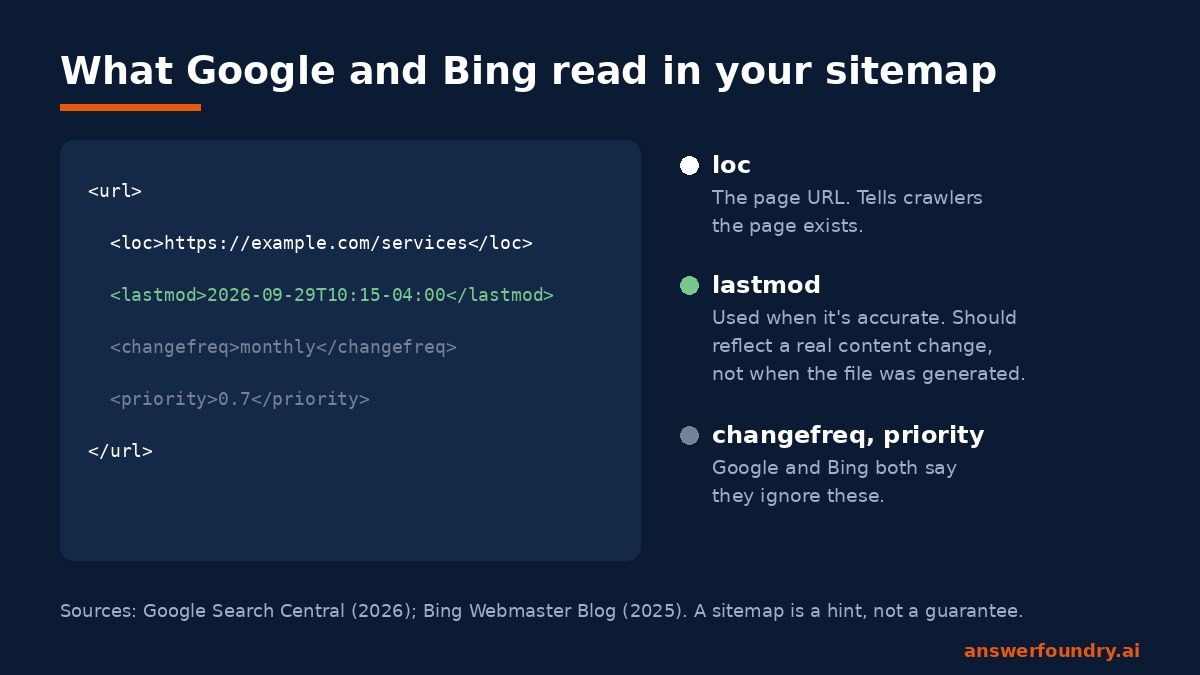
- Dates that don't mean anything. Every page shows the same
lastmoddate because the platform stamps the date the file was generated, not the date the content changed. - No one has told the search engines. The sitemap exists but isn't listed in robots.txt or submitted in Google Search Console or Bing Webmaster Tools.
Then we check the sitemap reports in both tools for the last time each engine read the file and any errors.
Available options
- Use what your platform generates. Google says WordPress, Wix, and similar platforms likely already publish a sitemap for you (Google Search Central, 2025b). Confirm it exists and lists the right pages.
- List it in robots.txt. Both Google and Bing read a
Sitemap:line in robots.txt (Google Search Central, 2026; Canel & Madhavan, 2025). - Submit it directly. Search Console shows when Googlebot accessed the sitemap and any processing errors (Google Search Central, 2026). Bing says it fetches a submitted sitemap right away and typically rereads it at least once a day (Canel & Madhavan, 2025).
- Pair it with IndexNow. Bing recommends sitemaps for full coverage plus IndexNow for instant notice of individual changes. We covered that in our post on IndexNow.
Benefits, limitations, and tradeoffs
The benefit is low cost for real coverage. A clean sitemap takes little effort to maintain and removes one reason a page might go unseen.
The limits are just as clear. Google calls submitting a sitemap "merely a hint" and says it doesn't guarantee Google will use it (Google Search Central, 2026). A sitemap doesn't fix thin content, inconsistent business details, or weak reviews, which are more often why an AI engine names a competitor. And inaccurate dates can work against you: Google says it uses lastmod only if it's consistently and verifiably accurate (Google Search Central, 2026).
What we know
Here's what the primary sources say, as of this post's date:
- Google says there are no additional requirements, special optimizations, or new machine-readable files needed to appear in AI Overviews or AI Mode. Standard SEO practices apply (Google Search Central, 2025a).
- Google ignores the
<priority>and<changefreq>tags. Bing says the same (Google Search Central, 2026; Canel & Madhavan, 2025). lastmodshould reflect the last significant change to the page, such as the main content, structured data, or links. Updating a copyright year doesn't count (Google Search Central, 2026).- Bing calls sitemaps "a foundational signal" for URL coverage in AI-powered search, while saying no tool can guarantee when or how content appears in AI-generated results (Canel & Madhavan, 2025).
- A single sitemap file can hold up to 50,000 URLs or 50MB uncompressed (Google Search Central, 2026).
What we haven't found is published documentation from OpenAI or Perplexity on how their own crawlers use sitemaps. We don't assume either way. For ChatGPT specifically, see whether you need Bing to show up in ChatGPT.
Next steps
Type your domain followed by /sitemap.xml into a browser (some platforms use /sitemap_index.xml). Check that your main service and location pages are listed and that the dates look like real edit dates. Then confirm the sitemap is submitted in Google Search Console and Bing Webmaster Tools. If everything checks out and you're still not showing up in AI answers, the sitemap isn't the problem. Our post on why ChatGPT may recommend a competitor covers the more common causes.
Orlando considerations
Many Central Florida businesses add pages over time for new service areas like Winter Park, Kissimmee, or Lake Nona. Those pages often get built quickly and never linked from the main navigation. If they're also missing from the sitemap, search engines may have no easy way to find them. Check that every location page is in the sitemap and linked from somewhere on your site. Internal linking and the sitemap do the same job from two directions.
Frequently asked questions
Does a sitemap get my business into AI Overviews?
Not by itself. A sitemap helps Google find and recrawl your pages. To appear as a supporting link in AI Overviews or AI Mode, a page has to be indexed and eligible to show with a snippet, and Google decides what to cite based on many other factors.
Do I need a special AI sitemap or file?
Google says no new machine-readable files, AI text files, or special markup are needed to appear in AI Overviews or AI Mode. A standard XML sitemap is enough.
Should I set priority and changefreq in my sitemap?
They don't hurt, but Google and Bing both say they ignore those tags. An accurate lastmod date matters more.
How do I find my website's sitemap?
Try yourdomain.com/sitemap.xml or yourdomain.com/sitemap_index.xml in a browser, or look for a Sitemap line in yourdomain.com/robots.txt. Most website platforms create one automatically.
References
Canel, F., & Madhavan, K. (2025, July 31). Keeping content discoverable with sitemaps in AI powered search. Bing Webmaster Blog, Microsoft. https://blogs.bing.com/webmaster/2025/7/Keeping-Content-Discoverable-with-Sitemaps-in-AI-Powered-Search/
Google Search Central. (2025a, December 10). AI features and your website. Google for Developers. https://developers.google.com/search/docs/appearance/ai-features
Google Search Central. (2025b, December 10). Learn about sitemaps. Google for Developers. https://developers.google.com/search/docs/crawling-indexing/sitemaps/overview
Google Search Central. (2026, July 8). Build and submit a sitemap. Google for Developers. https://developers.google.com/search/docs/crawling-indexing/sitemaps/build-sitemap
Last updated: September 29, 2026
Not sure whether search engines can find every page on your site, or why AI still names someone else? An AI visibility audit checks the basics like this and the harder signals, with a prioritized list of what to fix first.