Published October 17, 2026
Should I have a separate page for each service to show up in AI search?
Usually, yes. Give each real service you offer its own page that clearly answers what it is, who it's for, and what it costs or involves. AI engines break a customer's question into smaller searches and look for pages that match each one, and a focused page is easier to match than one long "Services" list. The catch is that the pages have to be genuinely different. Copy-paste pages with a word swapped are a known spam pattern and can work against you.
What this means
Many small-business websites have a single "Services" page that lists ten things in one paragraph each. That's fine for a human skimming, but it gives a search system very little to work with when someone asks a specific question like "who does emergency water heater replacement in Orlando" or "does anyone near me offer same-day crowns."
Google says both AI Overviews and AI Mode may use a "query fan-out" technique, issuing multiple related searches across subtopics and data sources to develop a response (Google Search Central, 2025a). Ahrefs' study of ChatGPT citations describes the same behavior: ChatGPT generates internal sub-questions and matches pages against them (Linehan, 2026). A page built around one service has a much better chance of being the obvious match for one of those sub-questions than a paragraph buried halfway down a catch-all page.
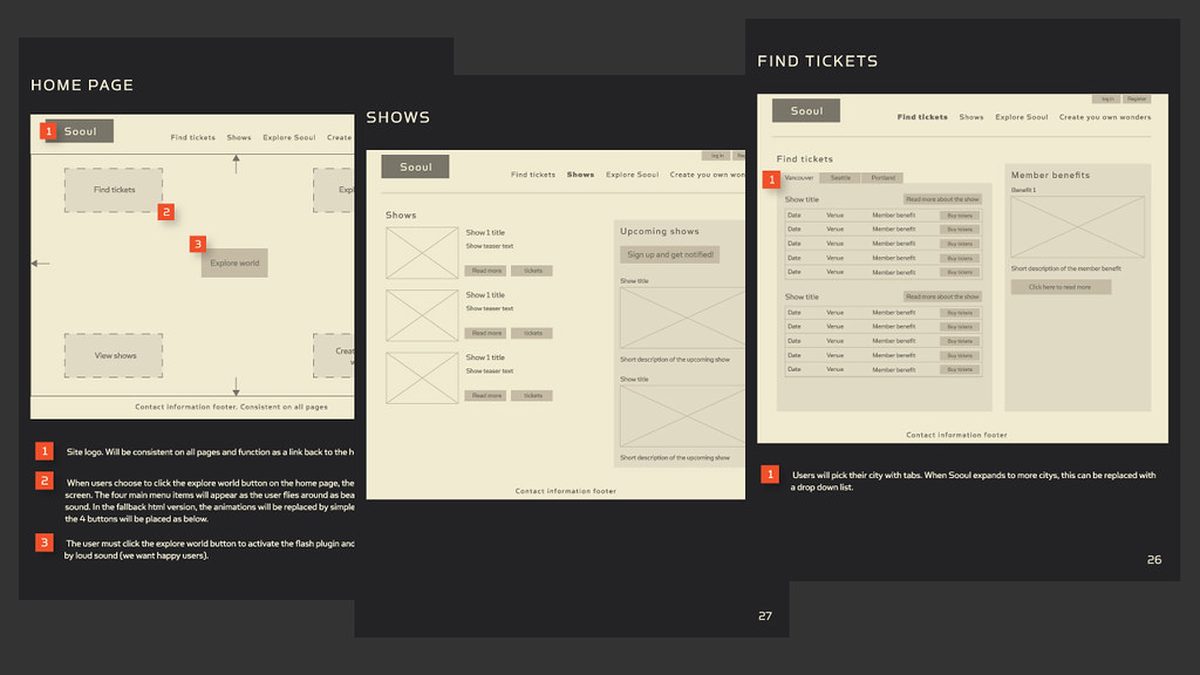
Photo: "Wireframes" by VFS Digital Design, CC BY 2.0
Who this applies to
This matters most for businesses that offer several distinct services that customers search for by name: dental and medical practices, law firms with more than one practice area, contractors and home-service companies, med spas, and accounting or financial firms. If you do one thing, such as a single-menu restaurant or a one-service specialist, a strong homepage and a good FAQ may cover it. The question to ask is whether a customer would type that service into a search box on its own. If they would, it probably deserves its own page.
How we'd evaluate it
We start by listing the questions real customers ask, then check which page on your site, if any, answers each one directly. We look at whether each service page has a descriptive title and a readable URL, whether the first paragraph answers the question plainly, and whether the page contains specifics a competitor's page wouldn't: your process, typical timelines, price ranges where you're comfortable sharing them, and who the service is and isn't right for. Then we run the same questions through ChatGPT, Perplexity, and Google's AI features to see which pages, yours or a competitor's, actually get cited.
Available options
- One page per core service. The usual recommendation for businesses with distinct offerings. Each page gets its own clear title, URL, and plain-language answer.
- A strong hub page plus individual pages. Keep a "Services" overview that links to each dedicated page, so both people and crawlers can find everything through internal links.
- Consolidated sections on one page. Reasonable when services are small variations of each other. Use clear headings for each so the content is still easy to pull apart.
- Service-plus-city pages. Only worth it when you have real, location-specific substance to add. Otherwise they slide into the doorway pattern described below.
Benefits, limitations, and tradeoffs
The benefit is a clearer match between a specific question and a specific page, which helps traditional search and AI search alike. The limitation is effort: a good service page takes real writing, and ten thin pages are worse than three useful ones. There's also a genuine risk in overdoing it. Google's spam policies describe doorway abuse as creating sites or pages "to rank for specific, similar search queries," and list examples including pages targeted at specific regions or cities that funnel users, and substantially similar pages that are closer to search results than a clearly defined, browseable hierarchy. The same document defines scaled content abuse as generating many pages primarily to manipulate rankings rather than help users (Google Search Central, 2026). The line is substance: a page that says something different and useful is fine, and a template with the service name swapped isn't.
What we know
Google's position is that there are no additional requirements or special optimizations needed to appear in AI Overviews or AI Mode, and that the foundational SEO practices still apply (Google Search Central, 2025a). Its SEO Starter Guide recommends thinking about the words a person might search for to find your content and using descriptive words in URLs (Google Search Central, 2025b). Separate service pages are simply a practical way to do both.
Two industry studies point the same way, with caveats. Ahrefs analyzed 1.4 million ChatGPT prompts and found that the titles of cited pages were more semantically similar to the prompt than those of retrieved-but-not-cited pages (0.602 vs. 0.484 cosine similarity), and that results with natural-language URL slugs had an 89.78% citation rate compared with 81.11% for those without (Linehan, 2026). Trakkr's analysis of 337,362 citations across 882 brands reported that service and use-case pages had a 1.87x "citation efficiency" relative to other page types (Trakkr Research, 2026). Both are correlational findings, not proof that adding a page will cause a citation, and both companies sell AI visibility tracking tools, so read them as useful signals rather than settled science.
Next steps
Write down your top five to ten services the way a customer would phrase them. For each one, find the page on your site that answers it. If the answer is "a bullet on the Services page," that's your shortlist for dedicated pages. Give each new page a title that names the service, a short readable URL, a first paragraph that answers the question directly, and specifics only you can provide. Link each one from your services hub and from related pages, and keep each service at one URL so you aren't creating duplicates.
Orlando considerations
Central Florida has a lot of overlap in categories like dental, legal, HVAC, roofing, and med spas, often with several businesses offering the same services within a few miles. When an AI engine is deciding which local provider to name for a specific service, a page that clearly describes that service, in your words, with your details, gives it something concrete to work with. Resist the urge to spin up a page for every suburb from Winter Park to Kissimmee unless each one has something genuinely local to say.
Frequently asked questions
How many service pages should a small business have?
One for each service a customer would actually search for by name and that you can describe in substance. For many local businesses that is somewhere between a handful and a couple dozen. If two services would get the same page with a word swapped, they probably belong on one page.
Should I also make a page for every city I serve?
Only if you have something genuinely different to say about each area, such as real projects, local requirements, or staff based there. Google's spam policies name pages targeted at specific regions or cities that funnel users as an example of doorway abuse.
Will adding service pages guarantee that ChatGPT or Google AI mentions my business?
No. AI engines are third-party systems that weigh many signals, including reviews, listings, and other websites. Clear service pages make your business easier to match to a question, but nobody can guarantee placement.
Do I need special markup or an AI file on each service page?
No. Google says there are no additional requirements or special optimizations needed to appear in AI Overviews or AI Mode, and that you don't need new machine-readable files or markup. Clear text, a descriptive title, and a crawlable page come first.
References
Google Search Central. (2025a, December 10). AI features and your website. Google for Developers. https://developers.google.com/search/docs/appearance/ai-features
Google Search Central. (2025b, December 10). SEO starter guide: The basics. Google for Developers. https://developers.google.com/search/docs/fundamentals/seo-starter-guide
Google Search Central. (2026, August 28). Spam policies for Google web search. Google for Developers. https://developers.google.com/search/docs/essentials/spam-policies
Linehan, L. (2026, April 15). Why ChatGPT cites one page over another (study of 1.4M prompts). Ahrefs. https://ahrefs.com/blog/why-chatgpt-cites-pages/
Trakkr Research. (2026, March 14). Service and use-case pages are the strongest overperformers. Trakkr. https://trakkr.ai/trakkr-research/page-type-performance/facts/service-and-use-case-pages-are-the-strongest-overperformers
Last updated: October 17, 2026
If you're not sure which of your services AI engines can actually match to your business, that's exactly what an AI visibility audit maps, with a prioritized list of what to fix first.