Published August 14, 2026
Is AI search reducing my website traffic?
Probably some of it — but unevenly, and not in the way most of the headlines suggest. The best independent measurement available found that people click a search result about half as often when an AI summary appears. Google's own data says total clicks to the web are roughly flat. Both of those can be true at the same time, and which one describes your business depends almost entirely on what kind of questions bring people to you.
What this means
The two claims aren't really in conflict. One measures what happens on a single search page; the other measures a global total. If AI summaries suppress clicks on the questions they can fully answer, while people simultaneously run more searches than before, the aggregate number can hold steady while individual sites feel a real loss. Traffic isn't so much disappearing as being redistributed — away from pages that exist to answer a quick factual question, and toward pages someone still needs to open to get value.
That reframes the question worth asking. It isn't "is AI taking my traffic," it's "how much of my traffic came from questions an AI can now finish without me?" For a business whose pages mostly answer "what is X" or "how much does Y cost," that share is large. For one whose pages exist to get someone to call, book, or buy, it's much smaller.
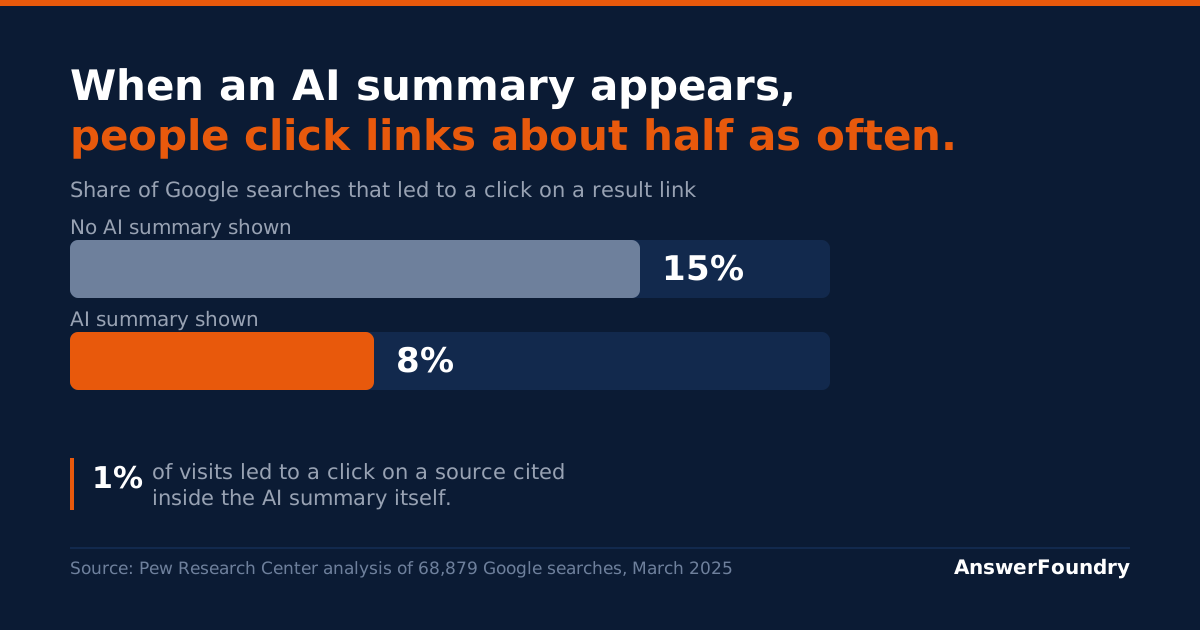
Chart by AnswerFoundry, built from Pew Research Center's March 2025 browsing data (Chapekis & Lieb, 2025).
Who this applies to
The businesses feeling this most sharply are the ones whose traffic was built on informational content — glossaries, "what is" explainers, cost guides, symptom pages, FAQ libraries. Those are precisely the queries that trigger AI summaries most often, and precisely the ones a user can finish reading without leaving the results page.
Local service businesses — dental and medical practices, law firms, contractors, home services — usually see a milder version, because picking a provider and contacting them still happens off the results page. But the research phase that used to bring someone to your blog first is increasingly happening inside the AI answer, which means the AI's description of you now does work your website used to do.
How we'd diagnose it
Google Search Console is the honest starting point, and there's a specific pattern worth looking for: impressions holding steady while clicks fall. That shape means people are still seeing you and choosing not to click — consistent with an answer being served above you. If impressions and clicks fall together, something else is going on, and Google's own troubleshooting guidance points to algorithmic updates, technical problems, or plain seasonality as more likely culprits (Google Search Central, 2025b).
From there: pull sixteen months rather than three, so an annual dip isn't mistaken for an AI effect, then sort the Pages table by click difference. That last check is the revealing one — a site-wide decline and a decline confined to your explainer pages call for completely different responses.
Available options
- Diagnose before reacting. Confirm the pattern in Search Console first. A meaningful share of "AI killed my traffic" reports turn out to be seasonality or a core update.
- Shift what informational pages are for. If a page's only job was to state a fact an AI now states for free, it needs a reason to be opened — original data, a worked example, local specifics, a tool, a real opinion.
- Add mention tracking to click tracking. If AI engines describe your business without sending a click, being described accurately becomes its own outcome. That's not measurable in Search Console, and it needs separate tracking.
Benefits, limitations, and tradeoffs
The honest limitation is that nobody can cleanly isolate this, including us. Google folds AI Overviews and AI Mode into the general "Web" search type in Search Console with no separate breakout (Google Search Central, 2025a). So you can see that clicks fell; you cannot see a line labeled "clicks lost to AI Overviews." Anyone selling you a precise figure for that is estimating and should say so.
The two headline sources also have real limits worth stating. Pew's analysis is a single month of browsing from 900 U.S. adults, Google only, and reflects how results looked when they were collected. Google's counter-data is self-reported, aggregate, and not independently auditable — and "total clicks across the entire web are flat" is entirely compatible with your particular site being down. Treat both as directional evidence, not as a verdict on your business.
What we know
Pew Research Center analyzed the browsing behavior of 900 U.S. adults across 68,879 Google searches in March 2025. Users who saw an AI summary clicked a traditional result link in 8% of visits, compared with 15% for users who didn't see one. Clicks on the sources cited inside the summary happened in just 1% of visits, and users were more likely to end their browsing session entirely — 26% of the time with a summary, versus 16% without (Chapekis & Lieb, 2025).
Google's position, published by its head of Search, is that total organic click volume from Search to websites has been "relatively stable year-over-year," with average click quality rising — quality meaning users who don't immediately click back. Google attributes the shift to people searching more and asking longer questions, and acknowledges plainly that traffic is moving between sites: some down, some up (Reid, 2025).
On what to actually do, Google's guidance is unusually direct: there are no additional requirements or special optimizations to appear in AI Overviews or AI Mode, no new machine-readable files, and no special schema — the existing SEO fundamentals are the mechanism (Google Search Central, 2025a). That's genuinely good news for the diagnosis, because it means the fix isn't a new proprietary technique someone has to sell you.
Next steps
Open Search Console, set the date range to sixteen months, and look at whether impressions and clicks moved together or apart. Then sort your Pages table by click difference and see which pages actually lost. If the losses cluster on informational content while your service and contact pages hold, you're seeing redistribution, not decline — and the response is to give those pages a reason to be opened, not to panic about the total.
Orlando considerations
Central Florida's service categories are dense enough that a customer's shortlist often forms during the research phase, before anyone visits a website. When that phase moves into an AI answer, being described accurately in the answer starts to matter as much as earning the click. Seasonality is also a real confounder here: tourism and snowbird cycles produce annual swings large enough to be mistaken for an AI effect, which is why the sixteen-month view matters more in this market than in a flatter one.
Frequently asked questions
Can I see AI Overview traffic separately in Google Search Console?
No. Google's documentation states that clicks and impressions from AI features are folded into the overall "Web" search type in the Performance report, with no separate breakout. You can measure your total search traffic accurately, but you cannot isolate exactly how much of a change was caused by AI Overviews specifically.
If my impressions are steady but my clicks are falling, is that AI?
It might be, but it isn't proof. Google lists other explanations for that same pattern, including weaker page titles and snippets, or a competitor earning a more appealing rich result. AI summaries are one plausible cause among several, which is why the diagnosis should start in Search Console rather than with an assumption.
Should I block AI crawlers to protect my traffic?
For Google specifically, that trade is unfavorable. Google treats AI as integral to Search, so the robots.txt control for AI Overviews is the same Googlebot control that governs ordinary search indexing. Blocking it removes you from AI answers and from regular Google results at the same time.
Does less traffic automatically mean less revenue?
Not necessarily. Traffic and revenue only move together if the lost visits were ones that converted. Plenty of businesses lose informational visits that were never going to become customers while keeping the high-intent visits that do. Track calls, forms, and booked appointments alongside sessions rather than watching session count alone.
References
Chapekis, A., & Lieb, A. (2025, July 22). Google users are less likely to click on links when an AI summary appears in the results. Pew Research Center. https://www.pewresearch.org/short-reads/2025/07/22/google-users-are-less-likely-to-click-on-links-when-an-ai-summary-appears-in-the-results/
Google Search Central. (2025a, December 10). AI features and your website. Google for Developers. https://developers.google.com/search/docs/appearance/ai-features
Google Search Central. (2025b, December 10). Debugging drops in Google Search traffic. Google for Developers. https://developers.google.com/search/docs/monitor-debug/debugging-search-traffic-drops
Reid, L. (2025, August 6). AI in Search is driving more queries and higher quality clicks. Google. https://blog.google/products-and-platforms/products/search/ai-search-driving-more-queries-higher-quality-clicks/
Last updated: August 14, 2026
If your traffic is down and you can't tell whether it's AI, a core update, or just the season, that's the first thing an AI visibility audit separates out — before anyone recommends a fix.