Published November 10, 2026
How do I get my business to show up in Microsoft Copilot answers?
Start with Bing, not Copilot. Microsoft says Copilot is powered by Bing's search index, and Bing's Webmaster Guidelines now spell out how content gets chosen as a source for Copilot answers. So the work is: make sure Bing can crawl and index your pages, write pages that each answer one question clearly, keep your business details accurate in Bing Places, and use Bing Webmaster Tools' AI Performance report to see whether Copilot already cites you. None of that guarantees a mention, but it covers the parts you control.
What this means
Most business owners treat AI visibility as a ChatGPT and Google question. Copilot gets skipped, even though it's built into Windows, Edge, and Microsoft 365, where a lot of people already work. When someone asks Copilot "who's a good estate planning attorney in Orlando," it doesn't reach for a list of ten blue links. It looks up sources, breaks them into smaller pieces, and puts together one answer from several of them (Madhavan, 2025).
The practical consequence: Copilot can only cite what Bing has indexed and can confidently use. A business that ranks well in Google but has never checked its Bing presence may simply not be in the pool Copilot draws from. That's the naive assumption worth correcting. Ranking in one search engine says nothing reliable about your standing in another engine's AI answers.
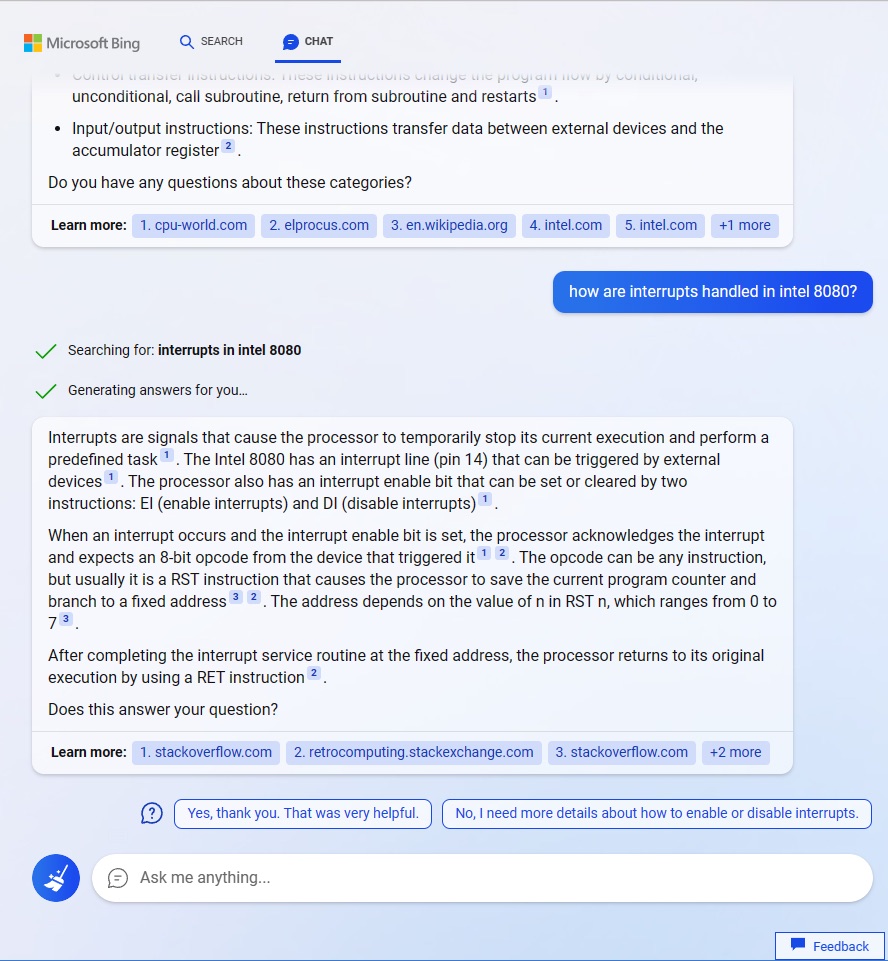
Image: "Bing search engine AI chat interface" by Microsoft, Mikko Paananen, CC0 1.0 (public domain dedication). An earlier version of the interface. Copilot's current design differs, but it still credits sources the same basic way.
Who this applies to
This matters most for businesses whose customers are likely to be on Microsoft's ecosystem when they ask: professional services that sell to other businesses (accounting, law, IT, commercial contractors), anyone whose buyers spend the workday in Windows and Outlook, and local service businesses that want coverage beyond Google. It matters less if your customers find you almost entirely through referrals or paid social, where AI-driven discovery isn't the main channel yet.
How we'd evaluate it
We'd check four things, in this order:
- Is the site verified and indexed in Bing Webmaster Tools? If Bing hasn't indexed your key service pages, nothing else on this list matters yet.
- Is Copilot already citing you? The AI Performance report shows how often your pages appear as sources in Copilot and in Bing's AI-generated summaries, which URLs get cited, and the "grounding queries" (the key phrases the AI used when it went looking for supporting content) (Madhavan et al., 2026).
- Are your robots meta tags limiting Copilot by accident? Directives like NOARCHIVE and NOCACHE affect AI answers differently than they affect regular search (Southern, 2026).
- Are your business details consistent? Name, address, hours, and phone number in Bing Places should match your website and your other listings.
Then we'd ask Copilot the questions a real customer would ask, in several phrasings, and record who it names. The report tells you whether you're cited. The prompts tell you who's getting cited instead.
Available options
- Do the Bing basics yourself. Verify your site in Bing Webmaster Tools (you can import it from Google Search Console), claim your Bing Places listing, and turn on IndexNow so Bing hears about changes quickly. All free.
- Restructure your key pages. Bing's updated guidelines favor pages that focus each URL on a single topic, put the essential information near the top, state facts directly, and use entity names consistently (Southern, 2026).
- Monitor it over time. Citation activity moves. Tracking the AI Performance report monthly, alongside real-prompt testing, shows whether changes are working.
Benefits, limitations, and tradeoffs
The upside is that Microsoft is unusually open here. Bing publishes guidelines that name Copilot directly and gives site owners a free citation report, which is more first-party visibility than most AI platforms offer. The limitations are real, though. The AI Performance report shows citation counts, not clicks, and Microsoft says the numbers don't indicate ranking, authority, or where you appear within an answer (Madhavan et al., 2026). The grounding-query data is a sample, and the report was still labeled a public preview at launch. There's also a tradeoff in the controls: blocking Copilot's use of your content with NOARCHIVE also removes you as a possible source.
What we know
Here's what Microsoft and its own documentation have said publicly, with dates:
- Copilot runs on Bing's index. Microsoft Advertising describes Copilot and related experiences as "powered by Bing's search index." It says traditional fundamentals like crawlability, metadata, internal linking, and backlinks still matter, but they're only the starting point. Copilot ranks pieces of content for inclusion in an answer, not just whole pages (Madhavan, 2025).
- Structure helps parsing. The same guidance recommends a page title, description, and H1 that agree with each other, descriptive H2/H3 headings instead of vague ones like "Learn more," Q&A pairs, and lists or tables for comparisons (Madhavan, 2025).
- There's a first-party citation report. On February 10, 2026, Bing launched AI Performance in Bing Webmaster Tools as a public preview. It covers Microsoft Copilot, AI-generated summaries in Bing, and select partner integrations. Bing's post also recommends IndexNow to keep content fresh, and Bing Places for Business to keep address, hours, and contact details "current and eligible for inclusion in AI-generated responses" (Madhavan et al., 2026).
- The guidelines now name Copilot and GEO. Search Engine Journal reported on February 27, 2026 that Bing rewrote its Webmaster Guidelines to cover Copilot and grounding results. According to that report, NOARCHIVE prevents content from being used in Copilot responses, NOCACHE limits Copilot to the URL, title, and snippet, and the guidelines now define generative engine optimization (GEO) while noting it doesn't guarantee citations. Large-scale content produced without editorial review may be excluded, and prompt injection aimed at Bing or Copilot is now treated as abuse (Southern, 2026).
Next steps
This week, verify your site in Bing Webmaster Tools and check that your main service pages are indexed. Claim or update your Bing Places listing so it matches your website exactly. Then ask Copilot three or four customer-style questions about your category and city, and write down who it names. In a few weeks, open the AI Performance report and see which of your pages, if any, are being cited.
Orlando considerations
Central Florida has a large professional-services base and plenty of businesses competing within a few miles of each other in law, accounting, home services, and healthcare. In a market that crowded, Bing Places is easy to overlook because most local marketing attention goes to Google Business Profile. That's exactly why it's worth checking: if a competitor's Bing listing is complete and yours is missing or out of date, Copilot has a clearer, more current record of them than of you.
Frequently asked questions
Does Microsoft Copilot use Bing or Google?
Microsoft says Copilot is powered by Bing's search index, and Bing's Webmaster Guidelines now explicitly cover how content is surfaced in Copilot. Ranking well in Google doesn't automatically mean Bing has crawled and indexed the same pages.
Can I see whether Copilot cites my website?
Yes, partially. The AI Performance report in Bing Webmaster Tools, in public preview since February 2026, shows how often your pages are cited across Copilot, AI-generated summaries in Bing, and some partner integrations. It shows citation counts and cited pages, not clicks, rankings, or placement within an answer.
Can a robots meta tag keep my content out of Copilot?
According to Search Engine Journal's reporting on Bing's updated guidelines, NOARCHIVE prevents content from being used in Copilot responses and grounding results, and NOCACHE limits Copilot to the URL, title, and snippet. Use these deliberately, because they also limit how richly you can be cited.
Can AnswerFoundry guarantee my business appears in Copilot?
No. Copilot is operated by Microsoft, and even Bing's own guidelines say optimizing for generative answers doesn't guarantee citations. What we can do is fix the signals within your control and measure whether citations move over time.
References
Madhavan, K. (2025, October 8). Optimizing your content for inclusion in AI search answers. Microsoft Advertising Blog. https://about.ads.microsoft.com/en/blog/post/october-2025/optimizing-your-content-for-inclusion-in-ai-search-answers
Madhavan, K., Merchant, M., Canel, F., & Nigam, S. (2026, February 10). Introducing AI Performance in Bing Webmaster Tools public preview. Bing Webmaster Blog. https://blogs.bing.com/webmaster/February-2026/Introducing-AI-Performance-in-Bing-Webmaster-Tools-Public-Preview
Southern, M. G. (2026, February 27). Bing adds GEO to official guidelines, expands AI abuse definitions. Search Engine Journal. https://www.searchenginejournal.com/bing-adds-geo-to-official-guidelines-expands-ai-abuse-definitions/568442/
Last updated: November 10, 2026
If you've never checked what Copilot says about your business, or whether Bing has indexed you at all, that's a gap an AI visibility audit is built to map, with a prioritized list of what to fix first.