Published August 29, 2026
ChatGPT is saying something wrong about my business. How do I fix it?
You can't edit an AI answer directly, and no one can promise you a correction on a deadline. What you can do is fix the sources the engine reads — your Google Business Profile, your website's structured data, and every directory that still carries the old detail — and then re-test until the answer changes. The error almost never originates inside the model. It originates in something public that still says the wrong thing.
What this means
Being left out of an AI answer and being described incorrectly inside one are different problems with different fixes. Absence usually means the engine wasn't confident enough to name you. A wrong detail means the opposite: it was confident, and the thing it was confident about is stale. Old hours. A suite number from two moves ago. A service you stopped offering. A phone number that rings a line you disconnected.
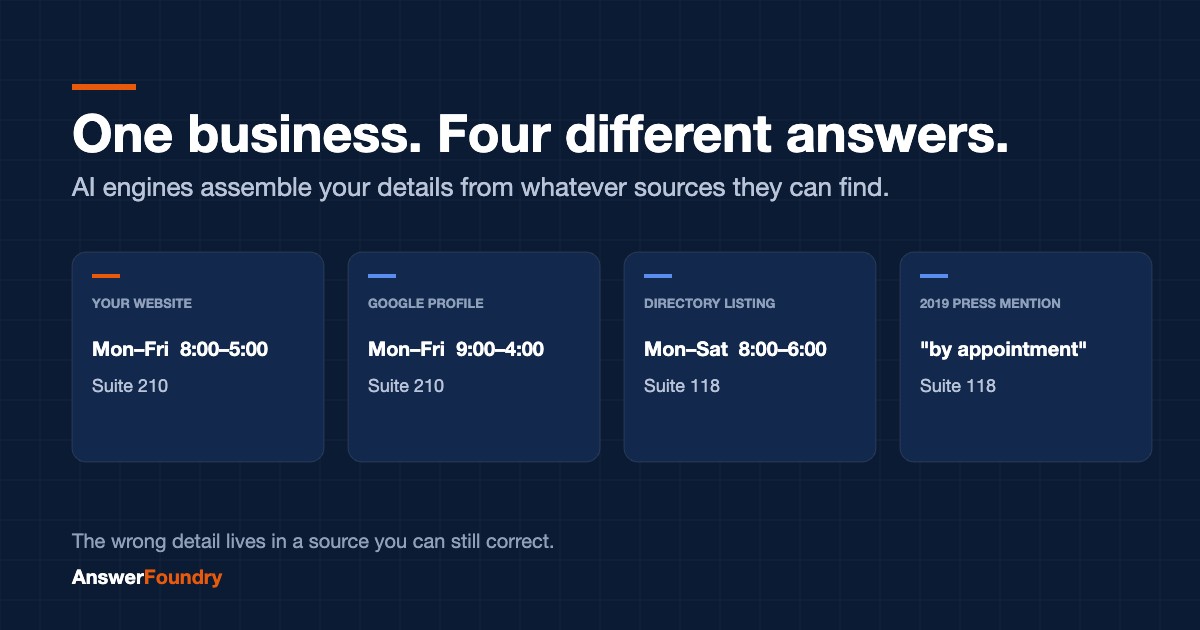
The reason this happens is that AI assistants don't hold a single authoritative record of your business. They assemble one, on the fly, from whatever public material they can retrieve and from patterns learned during training. When four sources say one thing and your updated website says another, the majority usually wins — and your site is only one vote.
Who this applies to
Any business whose operational facts have changed in the last few years, which is most of them. It matters most where the wrong detail has a direct cost: a law firm listing a practice area it no longer takes, a contractor showing a service radius that's grown, a clinic whose front desk fields calls about hours it hasn't kept since 2023. It matters less for businesses whose public details have been identical for a decade, though those are also the ones most likely to have an orphaned old listing nobody has looked at.
How we'd diagnose it
The first job is finding where the error lives, not arguing with the assistant. We ask the same question across several engines and phrasings and record exactly what each one returns, including the sources it cites when it shows them. Then we trace the wrong detail backward: does it appear on the Google Business Profile, in a directory listing, in an old press mention, in the site's own structured data, or in none of the above? An error that shows up on one engine and not the others usually points at a specific stale source. An error that shows up everywhere usually points at something you're still publishing yourself.
Available options
- Correct the Google Business Profile first. It's the highest-leverage single source for local facts, and it's the one you can edit directly. Google states that it also gathers business information from other sources, including user reports and licensed content, and may update your profile on its own — so check the profile editor for changes you didn't make (Google, n.d.-b; Google, n.d.-c).
- Fix your own structured data. Google's LocalBusiness documentation sets out the name, address, phone, and hours fields it expects (Google, n.d.-a). If your page renders correct hours to a human but carries old hours in the markup, you're publishing the error in the format machines read most readily.
- Clean up third-party listings. Directories, association pages, and aggregator profiles are frequently the source of a detail nobody on your team remembers entering. Each one is a separate correction.
- Link your profiles explicitly. The Schema.org sameAs property exists to state that two web presences are the same entity, using URLs that unambiguously identify it (Schema.org, 2026). It reduces the chance an engine merges you with a similarly named business or treats a duplicate listing as a separate one.
- Submit feedback in the assistant. Worth doing, low expected value on its own. Treat it as one input, not the plan.
Benefits, limitations, and tradeoffs
The upside of this work is that it's durable and it compounds: the same consistency that corrects a wrong hours listing also makes you easier to name in the first place. The limitation is that none of it is instant, and none of it is guaranteed. You are correcting inputs to systems that decide on their own schedule what to re-read and how much weight to give it. Some corrections show up in days. Some sit behind a training cycle you have no visibility into. Anyone who quotes you a turnaround time for an AI correction is quoting a number they cannot know.
What we know
Two things are documented rather than inferred. First, Google explicitly describes gathering business information from outside sources and updating profiles based on it, and provides both a "suggest an edit" path for profiles you don't manage and a review panel for changes it made to yours (Google, n.d.-b; Google, n.d.-c). That confirms the mechanism: the record about your business is being edited by parties other than you.
Second, on how reliably AI search tools handle sourcing at all — a Tow Center for Digital Journalism study published 6 March 2025 tested eight generative search tools on identifying the source of news excerpts and found they answered more than 60% of queries incorrectly. Perplexity, the strongest performer in that test, was still wrong on 37%. The researchers also observed that the tools rarely declined to answer, offering confident but incorrect responses instead (Jaźwińska & Chandrasekar, 2025). That study measured news attribution, not business listings, so it isn't a direct error rate for facts about your company. What it does establish is that confident-sounding output is not evidence of a verified source — which is exactly why a wrong detail can persist unchallenged.
What isn't documented: no major AI provider publishes how it weighs one source against another for business facts, or what triggers a re-read. Anything you're told about that is inference.
Next steps
Ask two or three engines to describe your business, in a customer's words rather than your own, and write down every factual claim each one makes. Check each claim against reality. For every mismatch, find the public page that still says it and correct that page. Re-test in two weeks, then again in six. The value is in the second and third tests, not the first — a single check tells you there's an error, but only the repeat tells you whether your fix reached the engine.
Orlando considerations
Central Florida has a high rate of business relocation, suite renumbering in multi-tenant medical and professional buildings, and rapid turnover in categories like med spas and home services. All three produce exactly the kind of stale-address and stale-hours records that end up in AI answers. The metro also has enough similarly named businesses within a short radius that entity confusion — an engine attributing one business's details to another — is a live risk here in a way it isn't in a thinner market.
Frequently asked questions
Can I contact ChatGPT or Gemini and ask them to correct it?
You can submit feedback inside most assistants, and it's worth doing. But feedback is not an edit queue with a service level agreement, and nobody outside those companies can tell you when or whether a specific correction lands. The reliable lever is fixing the underlying sources the engine reads, which you do control.
How long does a correction take to show up in AI answers?
It varies by engine and by which source carried the error. Assistants that search the live web can reflect a corrected page within days. Answers drawn from model training data or from a third-party directory that hasn't been re-crawled can lag much longer. Plan on re-testing over weeks, not hours.
The wrong detail came from an old news article. Can that be fixed?
Usually not by removing it, since you don't control the publisher. The practical approach is to make the current, correct information easier to find and better corroborated than the outdated version, so the engine has a clear and more recent basis for the accurate answer.
Does fixing my website alone solve it?
Rarely on its own. Your website is one source among many. If your Google Business Profile, directory listings, and social profiles still carry the old detail, the engine sees a corrected site outvoted by several stale sources. Corrections have to be made everywhere the fact appears.
References
Google. (n.d.-a). Local business (LocalBusiness) structured data. Google Search Central. https://developers.google.com/search/docs/appearance/structured-data/local-business
Google. (n.d.-b). Edit your Business Profile. Google Business Profile Help. https://support.google.com/business/answer/3039617
Google. (n.d.-c). Understand Google updates on your Business Profile. Google Business Profile Help. https://support.google.com/business/answer/3480441
Jaźwińska, K., & Chandrasekar, A. (2025, March 6). AI search has a citation problem. Columbia Journalism Review. https://www.cjr.org/tow_center/we-compared-eight-ai-search-engines-theyre-all-bad-at-citing-news.php
Schema.org. (2026). sameAs. Schema.org. https://schema.org/sameAs
Last updated: August 29, 2026
If an AI engine is describing your business with details that stopped being true a while ago, an audit maps every source still carrying the old version and puts them in the order worth fixing.