Published September 3, 2026
How often should I update my website content to stay visible in AI search?
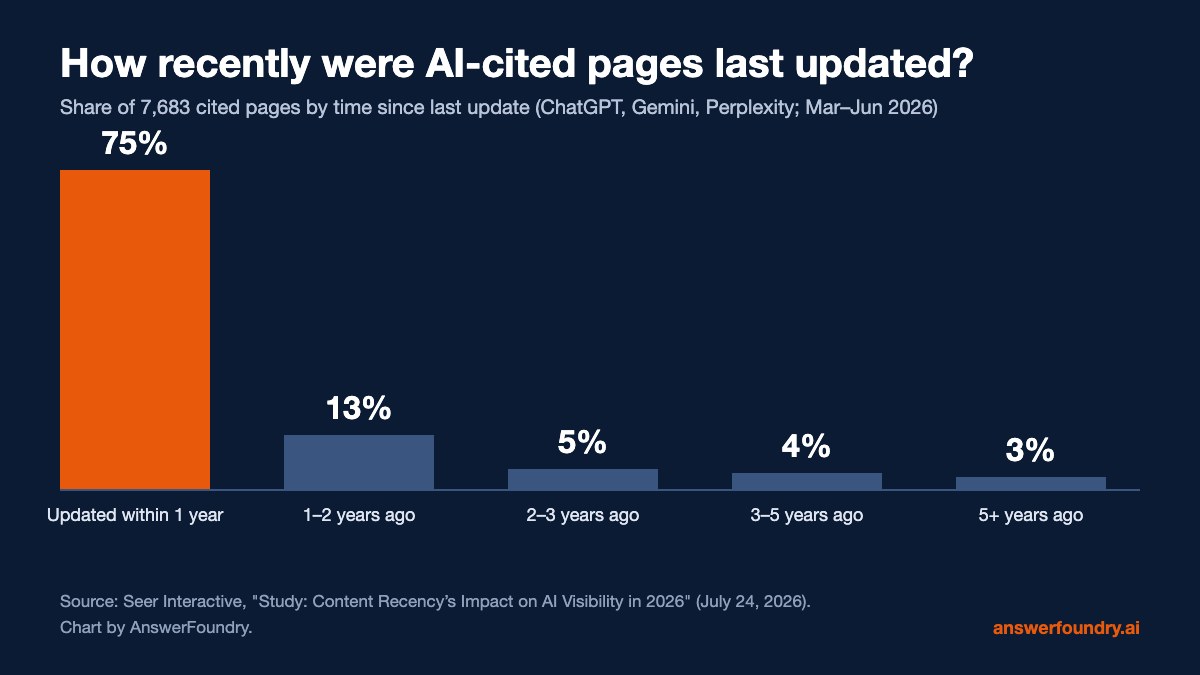
There is no fixed schedule that AI engines reward. What the data shows is that the pages ChatGPT, Gemini, and Perplexity cite skew toward recently maintained content: in a July 2026 Seer Interactive study, 75% of cited pages had been updated within the past year, and refreshed older pages outperformed brand-new ones. A practical cadence for most local and professional-service businesses is a real review of your core service pages every 3 to 6 months, with a visible, honest "last updated" date, and no fake date bumps.
What this means
The naive assumption is that "fresh" means "new." Publish more pages, more often, and the AI engines will notice. The evidence points the other way. What AI engines appear to reward is content that has been kept current, which is a maintenance habit, not a publishing volume habit. A five-year-old service page that was reviewed and corrected last month looks fresh to these systems. A page you wrote last year and never touched does not.
That distinction matters because most small businesses have a handful of pages that carry nearly all of their AI visibility: the homepage, two or three core service pages, an About page, and maybe an FAQ. Keeping those five or six pages accurate is a far smaller job than trying to feed a content calendar.
Who this applies to
Any business whose customers ask an AI engine a hiring question: "best estate planning attorney in Orlando," "who should I call for a slab leak in Winter Park," "top-rated med spa near Dr. Phillips." If your pages describe services, pricing, hours, staff, or credentials, those facts drift over time, and an AI engine reading a stale page has to guess whether it is still true. Businesses that sell almost entirely through referrals or paid ads have less at stake here, but the same pages still get read by these systems.
How we'd evaluate it
We start by listing which of your pages AI engines actually reference when they describe or recommend your business, then check three things on each one: when it was last substantively changed, whether that date is visible on the page and declared in structured data, and whether anything on it is now wrong (an old price, a service you no longer offer, a provider who left). Pages that are cited, stale, and inaccurate go to the top of the list. Pages that are cited, older, but still correct usually get left alone.
Available options
- Do nothing scheduled. Update pages only when something changes. This is what most businesses do, and it tends to fail quietly because nobody notices the change until a customer, or an AI engine, repeats the outdated fact.
- Set a fixed review cadence. Quarterly for service and pricing pages, twice a year for About and FAQ pages, and a once-over on older blog posts annually. Simple, predictable, and enough for most local businesses.
- Let citation data set the cadence. Track which pages AI engines cite month to month and refresh the ones that are cited often but aging. This is what Seer Interactive recommends over guessing at a schedule (Vasquez, 2026). It requires monitoring, which is why it pairs naturally with an ongoing visibility program.
Benefits, limitations, and tradeoffs
The benefit of a maintenance habit is that it compounds on pages you already own, with no new writing required. The limitation is that freshness is one factor among many, and it does not rescue thin or irrelevant content. Ahrefs put it plainly in its own study: low-quality content updated every day will not have a magic effect on AI visibility, and for many brands, new high-quality content may return more than extremely frequent updating (Law & Guan, 2025).
There is also a real tradeoff in how you signal freshness. Changing the date on a page without changing the content is the one thing every source agrees you should not do. Google's documentation says dates must describe when the page was published or significantly updated, and that user-visible dates and structured-data dates must match (Google Search Central, 2025). A date that moves while the content does not is a credibility problem, not a freshness signal.
What we know
Two independent studies and one platform document anchor the current picture.
75% updated within a year. Seer Interactive analyzed 7,683 pages carrying 47,097 citations across ChatGPT, Gemini, and Perplexity between March and June 2026. Three in four cited pages had been updated within the last year, and 88% within two. Of the pages updated in the past year, more than half had been touched within the previous three months (Vasquez, 2026).
Refreshed beats new. In the same study, when pages were measured by last-update date, 72% looked fresh. Measured by original publish date, only 42% did. More than a quarter of the "fresh" pages had first been published over two years earlier. The pages that stayed cited every month were older and maintained, with a median of about six months since their last update, while one-month citation spikes came from the newest pages (Vasquez, 2026).
Engines differ. Seer found Gemini the most freshness-heavy (78% of cited pages updated within a year), ChatGPT in the middle (73%), and Perplexity the most forgiving of older evergreen content (65%) (Vasquez, 2026). Ahrefs' earlier analysis of roughly 17 million citations across seven platforms reached a compatible conclusion: AI-cited URLs averaged 1,064 days since publication versus 1,432 days for Google's organic results, about 25.7% "fresher," with ChatGPT showing the strongest preference for newer pages and Google's AI Overviews showing almost none (Law & Guan, 2025).
How to declare a date. Google recommends a prominent, labeled, user-visible date such as "Last updated: [date]" plus datePublished and dateModified fields in Article or BlogPosting structured data, with the two kept consistent (Google Search Central, 2025). Google also notes it does not rely on any single date signal, so the visible date, the markup, and the actual content changes need to agree.
What we do not know: none of these studies isolate cause from effect. Recently updated pages may be cited more because they are fresh, or because the businesses that maintain pages also do other things well. Treat the numbers as a pattern, not a formula.
Next steps
List your five or six most important pages. For each, write down the last date the content genuinely changed. If it is more than six months ago, read the page as a stranger would and fix anything that is no longer accurate. Add or correct a visible "Last updated" line and matching dateModified markup, but only on pages where you actually changed something. Then put a recurring reminder on the calendar and repeat in three months.
Orlando considerations
Central Florida businesses change faster than most: seasonal hours, hurricane-season service adjustments, new locations along the I-4 corridor, and staff turnover in healthcare, legal, and home-services practices. Each of those is a fact an AI engine may repeat from a stale page. In a market with several similarly positioned competitors within a few miles, the business whose pages are demonstrably current gives the engine less reason to hedge or pick someone else.
Frequently asked questions
Does changing the "last updated" date without editing the page help?
No. Google's documentation says dates must reflect when the page was published or significantly updated, and that visible and structured-data dates must match. A moving date on unchanged content is a trust problem, and it does nothing for the AI engines that read the actual text.
Should I update old blog posts or write new ones?
Both have a place, but the data favors maintaining pages that already earn citations. Seer Interactive found the pages cited consistently month after month were older, maintained pages, while brand-new pages produced short spikes. Ahrefs cautions that very frequent updating has an opportunity cost and that new, high-quality content may pay off more for many brands.
How quickly do AI engines notice an update?
It varies by engine and by how often your site is crawled, from days to several weeks. Perplexity and ChatGPT tend to pick up changes faster than Google's AI Overviews. See our separate post on how long new content takes to appear in AI search.
Does this guarantee my business will be cited?
No. No one can guarantee placement, ranking, or citation inside any AI-generated answer, including AnswerFoundry. Freshness is one signal among many, and the engines are third-party systems that change without notice.
References
Google Search Central. (2025, December 10). Influence your byline dates in Google Search. Google for Developers. https://developers.google.com/search/docs/appearance/publication-dates
Law, R., & Guan, X. (2025, July 28). New study: AI assistants prefer to cite "fresher" content (17 million citations analyzed). Ahrefs Blog. https://ahrefs.com/blog/do-ai-assistants-prefer-to-cite-fresh-content/
Vasquez, S. (2026, July 24). Study: Content recency's impact on AI visibility in 2026. Seer Interactive. https://www.seerinteractive.com/insights/study-content-recencys-impact-on-ai-visibility-in-2026
Last updated: September 3, 2026
If you don't know which of your pages AI engines are actually reading, or when they were last accurate, that's the first thing an AI visibility audit maps.