Published October 19, 2026
How do restaurants show up in AI search results?
Restaurants show up in AI answers mostly through information the restaurant already controls: its Google Business Profile, its listings on directories and reservation platforms, and its own website. For restaurants specifically, reviews matter more than they do in most industries. There’s no sign-up or fee that gets you named. AI engines pull from the sources they trust and then decide for themselves which places to mention.
What this means
When someone asks ChatGPT, Gemini, Perplexity, or Google’s AI Mode “where should we get dinner tonight,” the engine doesn’t scroll through a list the way a person would. It pulls facts from sources it can reach, such as business listings, maps data, reservation platforms, review sites, and restaurant websites, and puts together a short answer. Whether your restaurant is in that answer depends on whether those sources describe you clearly and accurately, and whether you fit what the person asked for.
Restaurants are also one of the first categories where AI search can go past recommending and actually act. Google says AI Mode can search across reservation platforms for real-time availability that matches a request with several conditions, such as party size, time, and cuisine, and then link the diner straight to the booking page (Stein, 2025). In November 2025 Google said this agentic restaurant booking was rolling out in AI Mode across the U.S., with no Labs opt-in required (Farago, 2025). So for restaurants, being visible to AI can now also mean being bookable through it.
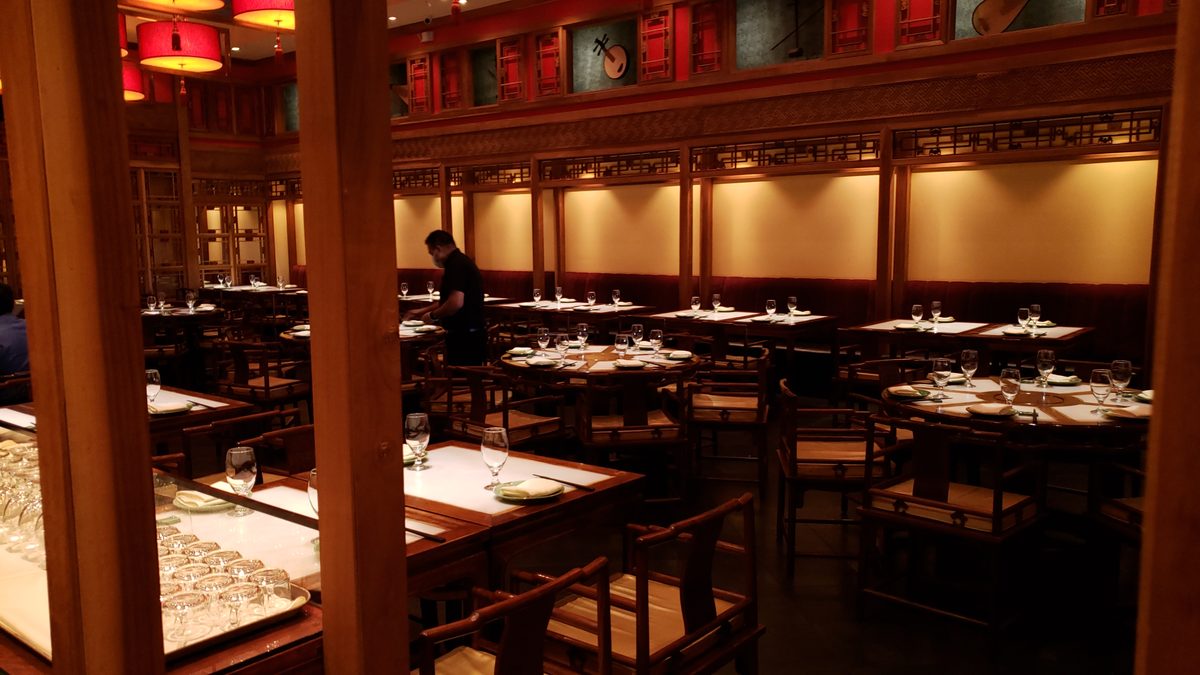
Photo: "Bistro Nas restaurant interior dining room southwest angle" by George Ho, CC BY-SA 4.0
Who this applies to
This applies to any food and drink business that gets customers through discovery rather than only through regulars: sit-down restaurants, cafés, bars, bakeries, food halls, and catering kitchens with a public location. It matters most for places that take reservations or depend on visitors who don’t already know the neighborhood. A ghost kitchen that only sells through delivery apps will be represented mostly by those apps’ listings, so it has fewer levers of its own.
How we’d evaluate it
We’d start by asking the engines the questions real diners ask, like “best brunch near [neighborhood],” “quiet Italian place for a date in [city],” or “restaurant that can seat 10 on a Friday,” on more than one engine and with more than one phrasing. Then we’d trace each answer back to where it likely came from. Is your Google Business Profile complete, with current hours and a menu? Do the reservation platforms you use show the same name, address, and phone number as your website? Is your menu on your own site as real text, or only as a photo or PDF? When AI gets something wrong, like a dish you no longer serve or old hours, there’s usually a stale source somewhere feeding it.
Available options
- Keep your Google Business Profile menu current. Google’s menu editor is open to food and drink businesses. Google says it may transcribe menu data from your website, can show several menu sources along with when each was last updated, and that edits can take 24–48 hours to appear on Maps and Search (Google Business Profile Help, n.d.-a).
- Claim your dish names. Owners and customers can both add photos and names of dishes, and Google says dish names added by the owner take precedence over those added by customers (Google Business Profile Help, n.d.-b).
- Be bookable where AI looks. Google has named OpenTable, Resy, and Tock among the partners behind AI Mode’s reservation feature (Stein, 2025). If you take reservations, a working listing on a platform you already use is worth checking. We aren’t telling you to pay for a new one.
- Publish a text menu and the basic facts on your own site. Hours, address, cuisine, price range, dietary options, and whether you take groups are the details AI engines need to match you to a specific request.
- Earn specific reviews. Reviews that mention particular dishes and occasions give engines something concrete to repeat.
Benefits, limitations, and tradeoffs
Most of this work is cheap, and it pays off beyond AI. Accurate hours and menus help every diner who checks Google Maps, too. The limitations are real, though. You can’t control which sources each engine picks, how it weighs them, or whether it names you at all. Agentic booking also runs through third-party reservation platforms, which have their own fees and terms. Consistency takes ongoing work, because restaurants change menus, hours, and specials far more often than most businesses, and every change creates a chance for one listing to fall out of date.
What we know
The most detailed public data we found comes from Yext, which analyzed 6.8 million citations from ChatGPT, Gemini, and Perplexity collected between July 1 and August 31, 2025, across four industries including food service (Yext, 2025). Yext sells listings-management software, so keep that in mind when reading its conclusions. Across all four industries, first-party websites made up 44% of citations and listings 42%, and Yext reports that 86% of citations came from sources brands already control. The engines differed: Gemini favored websites (52.1%), while OpenAI’s model leaned on listings (48.7%). For food service specifically, Yext found that listings were the largest single source at 41.6%, and that reviews and social content made up 13.3% of citations, the highest share of any industry it studied (Yext, 2025).
On the Google side, the company describes AI Mode’s restaurant reservations as drawing on live web browsing, direct partner integrations, its Knowledge Graph, and Google Maps (Stein, 2025). That’s a good reason to treat your Business Profile and Maps listing as core infrastructure rather than an afterthought. Beyond that, no AI provider publishes the exact formula for which restaurant gets named.
Next steps
This week, ask two or three AI engines the questions your guests actually ask, and write down who gets named and what each engine says about you. Then check your Google Business Profile menu and hours, your reservation listing, and your website menu against each other. Fix anything that doesn’t match before you work on anything more advanced.
Orlando considerations
Orlando’s restaurant scene serves two very different audiences: locals and a steady flow of visitors who don’t know the area and are more likely to ask an assistant for a recommendation. Many restaurants here also sit inside or near resorts, attractions, and large shopping districts, where similar names and shared addresses make it easy for listings to get mixed up. Clear, consistent location details and a complete Business Profile help AI engines tell your place apart from the one down the corridor.
Frequently asked questions
Can I pay to have my restaurant recommended by ChatGPT or Google AI?
There’s no general way to buy a place in an AI answer. Engines draw on listings, maps data, websites, and reviews, and they decide on their own who to name. What you can control is how accurate and complete those sources are.
Do I need to be on OpenTable, Resy, or Tock to be booked through Google AI Mode?
Google has named OpenTable, Resy, and Tock among the partners behind AI Mode’s reservation feature. A restaurant that doesn’t take online reservations can still be recommended, but it can’t be booked through that flow. Whether a reservation platform is worth its fees is a business decision for each restaurant.
Why does AI show an old menu or wrong hours for my restaurant?
Usually some source it reads is out of date, such as an old PDF menu, a directory listing, or an unclaimed profile. Google notes it may pull menu data from your website and show several menu sources, so updating your own site and your Business Profile together is the first fix.
Do reviews matter more for restaurants than for other businesses?
In Yext’s 2025 citation study, reviews and social content made up a larger share of AI citations for food service than for any other industry it studied, though listings were still the largest single source. Specific, recent reviews give engines more to work with.
References
Farago, J. (2025, November 17). New ways to plan travel with AI in Search. Google The Keyword. https://blog.google/products-and-platforms/products/search/agentic-plans-booking-travel-canvas-ai-mode/
Google Business Profile Help. (n.d.-a). About the menu editor. Google. Retrieved October 19, 2026, from https://support.google.com/business/answer/9455840?hl=en
Google Business Profile Help. (n.d.-b). Find and edit popular dishes for restaurants. Google. Retrieved October 19, 2026, from https://support.google.com/business/answer/9322475?hl=en
Stein, R. (2025, August 21). AI Mode in Search gets new agentic features and expands globally. Google The Keyword. https://blog.google/products-and-platforms/products/search/ai-mode-agentic-personalized/
Yext. (2025, October 9). Yext research: 86% of AI citations come from brand-managed sources, clarifying how marketers can compete in the AI search era. Yext. https://www.yext.com/about/news-media/ai-citations-release
Last updated: October 19, 2026
If AI engines are naming the restaurant down the street instead of yours, or describing your menu wrong, an AI visibility audit maps which sources are feeding those answers and what to fix first.