Published September 21, 2026
Does my business need a Wikidata entry to show up in AI search?
Short answer: no, not as a requirement — but Wikidata is one of the few individual data sources worth building on purpose. A meaningful share of Google's Knowledge Graph is built from it, and that graph now doubles as retrieval infrastructure behind AI Overviews, AI Mode, and Gemini.
What this means
Wikidata isn't Wikipedia wearing a different name. Wikipedia is the encyclopedia people read — paragraphs, citations, prose. Wikidata is the structured database sitting behind the scenes: a machine-readable record of facts about an entity, such as its type, industry, location, official website, and links to other profiles that describe the same thing. As of today, Wikidata holds 123,429,634 items (Wikidata Foundation, 2026), and unlike a Wikipedia article, it's built to be queried directly by machines.
The connection to your own website runs through a single schema.org property called sameAs, whose entire job is telling a search or AI system "this page and that record describe the same entity." Schema.org's own documentation lists a Wikidata entry as one of the standard examples of what belongs in that field, alongside a Wikipedia page or official website (Schema.org, 2026).
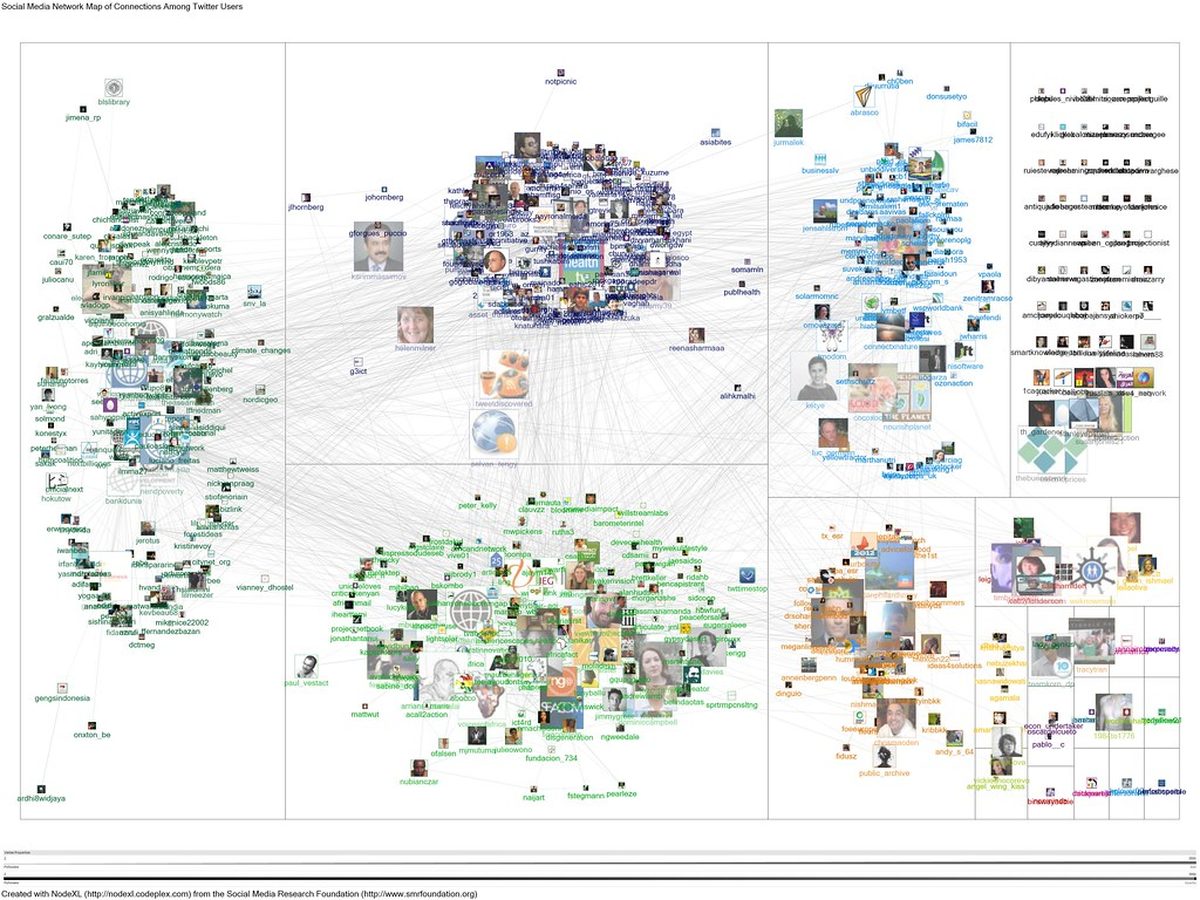
Photo: "20110620-NodeXL-Twitter-Worldbank network graph" by Marc_Smith, CC BY 2.0.
Who this applies to
This is most useful for businesses an AI engine has real reason to hesitate over — a name shared with other companies, a newer brand without much press history, or a business in a category where naming the wrong entity is a bigger problem, such as legal, medical, or financial services. A business with an unusual name, years of consistent local press, and an existing Google Knowledge Panel gets a smaller marginal benefit from adding one, though it's rarely wasted effort.
How we'd evaluate it
A proper check starts with confirming whether an item already exists — searching your exact business name at wikidata.org takes under a minute and tells you immediately. If one exists but is thin, missing your website, industry, or linked social profiles, the job is filling gaps, not starting over. If nothing exists, we check whether the business clears Wikidata's notability bar first: independent, verifiable sources such as press coverage, industry directories, or licensing records, not statements sourced only to the business's own site (Gavoyannis, 2026). A business with no outside coverage at all typically needs PR work before a Wikidata item will hold.
Available options
There are three ways to act on this:
- Create the item yourself. Free and possible, but every statement needs a citable, independent source — Wikidata's volunteer editors are specifically trained to revert self-promotional or unsourced edits.
- Have someone research, draft, and source it for you. Faster and less likely to be reverted for sourcing problems, but acceptance is still decided by Wikidata's own volunteer community — not by us, and not by any fee.
- Skip it for now and fix cheaper signals first. NAP consistency and on-site schema markup are faster to control directly and often matter more in the short term. Sequencing beats doing everything at once.
Benefits, limitations, and what a Wikidata entry won't do
The benefit is leverage: one well-sourced record feeds Google's Knowledge Graph, which now functions as retrieval infrastructure for AI Overviews, AI Mode, and Gemini, not just Knowledge Panels (Gavoyannis, 2026). The limitations are real. Acceptance isn't guaranteed — Wikidata's notability policy exists specifically to keep out unsourced or promotional entries, and in June 2025 Google removed more than three billion entities from the Knowledge Graph in a single week, a move read as prioritizing a smaller, higher-quality dataset over raw size (Gavoyannis, 2026). A thin, unsourced Wikidata item is more likely to be excluded now, not less. And a Wikidata entry doesn't substitute for the basics: inconsistent name, address, and phone details across your own site and listings will undercut it regardless of what Wikidata says.
What we know
None of the major AI providers publish the exact formula for how the Knowledge Graph feeds their answers, and what's publicly documented changes often. What is documented: Google's own support materials describe Knowledge Panels as generated automatically, with facts drawn "from a variety of sources that compile factual information" across the open web, rather than submitted directly by most businesses (Google Search Help, n.d.). Separately, the sameAs property — the mechanism that links a Wikidata record to your own website — is now used on more than 10 million domains, based on Google's own monthly web-index aggregation (Schema.org, 2026), which puts it well outside "niche technical trick" territory.
Next steps
Check this week whether your business already has a Wikidata item by searching your exact business name at wikidata.org. If one exists, confirm it links your correct, current website. If nothing exists, the prerequisite isn't the Wikidata edit itself — it's having independent, citable coverage to point to. Chase that first.
Orlando considerations
Central Florida markets with several similarly named or similarly positioned businesses — med spas, law firms, home services — give an AI engine more competing options to sort through when it's deciding who to name. That's exactly the situation entity disambiguation tools like Wikidata are built for, so the marginal value tends to run higher here than in a market with less name overlap.
Frequently asked questions
Is a Wikidata entry the same as a Wikipedia page?
No. Wikipedia is prose written for readers; Wikidata is a structured, machine-readable record of facts. Wikidata's notability bar is generally lower, and industry reporting describes it as considerably more achievable for most businesses than getting a Wikipedia page accepted.
Can AnswerFoundry create my Wikidata entry for me?
We can research, draft, and source the statements a Wikidata item needs. We don't guarantee it gets accepted or stays up — that decision belongs to Wikidata's own volunteer editors, not to us or to any fee.
How long before a new Wikidata item shows up in an AI answer?
There's no published timeline. The item has to be accepted by Wikidata's editors, then picked up by Google's Knowledge Graph and by whichever AI systems draw on it, and each of those steps runs on its own schedule.
Does my business need to be "notable" to get a Wikidata item?
Yes. Wikidata requires independent, verifiable sources for the facts in an item — statements sourced only to your own website don't meet that bar on their own.
References
Gavoyannis, D. (2026, May 14). Google's Knowledge Graph explained: How it influences SEO & AI search. Ahrefs. https://ahrefs.com/blog/google-knowledge-graph/
Google Search Help. (n.d.). How Google's Knowledge Graph works. Google. https://support.google.com/knowledgepanel/answer/9787176?hl=en
Schema.org. (2026, September 16). sameAs – Schema.org property. Schema.org. https://schema.org/sameAs
Wikidata Foundation. (2026, September 21). Wikidata:Statistics. Wikidata. https://www.wikidata.org/wiki/Wikidata:Statistics
Last updated: September 21, 2026
If you're not sure whether your business already has a Wikidata item — or whether it's accurate — that's exactly the kind of gap an AI visibility audit is built to catch, with a prioritized list of what to fix first.