Published September 20, 2026
Does my business need a Spanish-language website to show up in AI search?
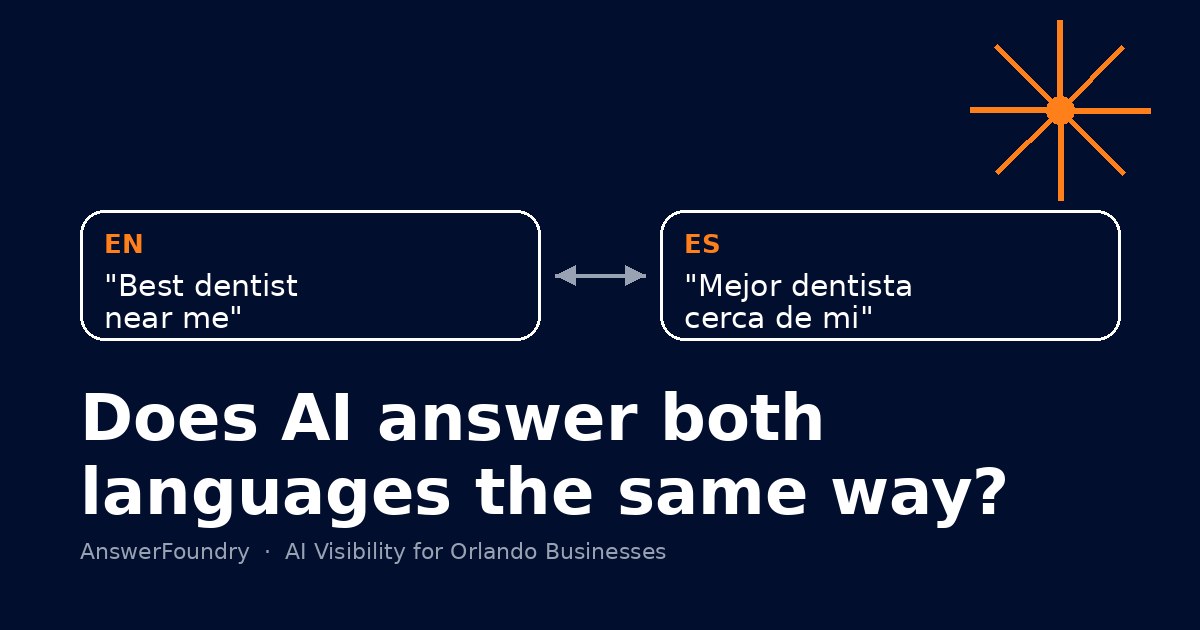
Run this test twice: ask ChatGPT or Google AI the same question first in English, then in Spanish — "best [your service] near me" and "mejor [su servicio] cerca de mí." If your business shows up in one language and disappears in the other, that's not a glitch. It's the most consistent pattern researchers have documented in how AI engines handle multilingual businesses, and in a market where more than a third of the population is Hispanic, it isn't a minor gap.
What this means
AI engines strongly favor content written in the language of the question being asked. A business can be well-established, well-reviewed, and clearly the right answer for a Spanish-speaking searcher, and still get skipped, because the engine has nothing in Spanish it can confidently cite. A 2026 study that analyzed 1.3 million citations across Google AI Overviews and ChatGPT found that untranslated Spanish-language websites received 17,094 citations for Spanish-language queries but only 2,810 for the equivalent English queries, a 431% gap, among a sample of high-traffic sites in Spain; a comparable sample in Mexico showed a 213% gap (Pokorny, 2026; Ernoult, 2025).
Independent testing across AI platforms found the same underlying problem from a different angle. When a page had genuinely been translated and tagged correctly for both languages, Google's AI Overviews, AI Mode, Gemini, and Copilot typically returned the correct-language version. ChatGPT, Perplexity, and Claude did not: in repeated tests searching in French, Italian, and Spanish, those three platforms frequently returned the English-language page even when a properly translated version existed and was linked to it (Gabe, 2025).
Who this applies to
Any Orlando-area business whose customers might reasonably ask a question in Spanish. That's not a niche slice of the market here: 35.4% of Orlando's population identifies as Hispanic or Latino, about 113,000 people, and roughly one in four residents was born outside the United States (Data USA, 2026, drawing on the U.S. Census Bureau's 2024 American Community Survey estimates). This matters most for categories where the deciding factor is trust and clear communication rather than price alone — medical and dental practices, legal services, home services, and other businesses where a customer is likely to ask an AI assistant directly rather than dig through a page of search results.
How we'd evaluate it
A proper audit checks whether a business has any Spanish-language content at all, and if so, whether it's built in a way search and AI engines can actually index — a real, standalone page with its own URL, not a browser-based auto-translate overlay. It checks whether hreflang tags connect the English and Spanish versions to each other, following Google's own specification for telling search engines about localized versions of a page (Google Search Central, 2025). And it tests the same real customer questions in both languages across ChatGPT, Perplexity, and Google AI Overviews to see whether the business appears, disappears, or gets replaced by a competitor depending on which language is used.
Available options
- Do nothing and confirm the assumption. Reasonable if a business's customer base is genuinely English-dominant — but worth checking with the two-language test above rather than assuming.
- Translate the highest-intent pages. Services, hours, location, and the specific questions customers ask, published as real indexable pages with hreflang tags connecting them to their English counterparts.
- Full bilingual site with ongoing monitoring. Tracks whether the visibility gap between languages actually closes over time, across more than one AI engine.
Benefits, limitations, and tradeoffs
The same 2026 study found that when a business did translate its site, the visibility gap narrowed sharply and overall citations increased: translated sites picked up 327% more AI Overview visibility on the non-primary-language queries compared to untranslated sites, and also gained more citations in their original language — suggesting translation reads to these systems as a broader signal of authority, not just a way to reach a second audience (Pokorny, 2026).
The limitations are real. None of the major AI platforms publish exactly how they weigh translated content in choosing what to cite. The underlying research is specific to Spanish-English site pairs in Spain and Mexico, not Orlando specifically, so the exact percentages shouldn't be treated as a local guarantee. And Gabe's independent testing (2025) found real inconsistency even among sites that had done everything correctly — Perplexity and Claude returned the wrong-language version in several tests despite a correct, properly tagged version existing. Translation improves the odds of being found in both languages. It doesn't guarantee it in either.
What we know
What's consistent across this research is that AI engines treat language as one of the strongest signals for which source to cite, more consistently than they treat many of the technical SEO factors businesses spend more time worrying about. Google and Bing, and the AI features built on their infrastructure, have had decades to refine multilingual matching and it shows. ChatGPT, Perplexity, and Claude are newer at this and, as of this testing, noticeably less reliable at it (Gabe, 2025). Businesses that wait for those platforms to solve this problem on their own are leaving a real, measured gap unaddressed in the meantime.
Next steps
Check which of your pages, if any, currently exist in Spanish. If none do, that's the starting point. If some do, check whether they use hreflang tags connecting them to the English version, or whether they're a translation-widget overlay that search and AI crawlers may not treat as a separate page at all. Then run the two-language test from the top of this article on two or three AI engines and write down exactly what came back in each language, including who else got named.
Orlando considerations
This is one of the few AEO factors where the local numbers aren't a general caveat — they're the reason the topic is worth addressing at all here. Orlando's population is 35.4% Hispanic or Latino, and about one in four residents were born outside the U.S. (Data USA, 2026). A business serving this market that has no Spanish-language presence isn't dealing with a hypothetical edge case; it's likely invisible to a meaningful share of the AI-driven searches happening in its own service area, for exactly the reason described above.
Frequently asked questions
Does a Google Translate widget on my site count as a Spanish-language website?
No. Browser-based translation widgets and automated translation proxies don't create a separate, indexable page that AI engines can find and cite on their own. One case in the Weglot dataset showed a retailer's traffic being intercepted by an automated translation proxy instead of reaching the retailer's own site. Getting credit for a translated page generally requires a real page with its own URL.
Do I need a fully bilingual site, or just a few key pages?
The research we cite doesn't test that specific tradeoff, so we can't point to a number for it. What is established is that untranslated content is largely invisible to AI answers generated in the other language. Translating your highest-intent pages, such as services, hours, location, and the questions customers actually ask, is a reasonable starting point rather than an all-or-nothing project.
Does this work the same way across ChatGPT, Google AI, and Perplexity?
No. Independent testing found Google's AI Overviews and AI Mode, along with Gemini and Copilot, were noticeably more consistent at returning the correct-language version of a page than ChatGPT, Perplexity, and Claude, which repeatedly returned English pages even when the searcher was querying in Spanish. A business can't assume good behavior on one platform carries over to another.
Will translating my site guarantee AI recommends me to Spanish-speaking customers?
No, and you should be skeptical of anyone who guarantees placement in a system they don't control. What the data supports is that untranslated content carries a measurable visibility disadvantage in the other language. Fixing that removes a real barrier, but it doesn't guarantee a specific outcome on any given engine.
References
Data USA. (2026). Orlando, FL [Data profile based on U.S. Census Bureau 2024 American Community Survey 5-year estimates]. https://datausa.io/profile/geo/orlando-fl
Ernoult, E. (2025, November 14). Data: Translated sites see 327% more visibility in AI Overviews. Search Engine Journal. https://www.searchenginejournal.com/translated-sites-boost-ai-visibility-weglot-spa/559900/
Gabe, G. (2025, December 1). AI search, hreflang, and translated content: How do ChatGPT, Perplexity, Gemini, Copilot, and Claude handle multilingual queries? The Internet Marketing Driver (GSQi). https://www.gsqi.com/marketing-blog/ai-search-hreflang-multilingual-queries/
Google Search Central. (2025, December 22). Tell Google about localized versions of your page. Google for Developers. https://developers.google.com/search/docs/specialty/international/localized-versions
Pokorny, E. (2026, August 10). Does AI favor translated content? (+1.3 million citations analyzed). Weglot. https://www.weglot.com/blog/multilingual-seo-ai-visibility
Last updated: September 20, 2026
If you're not sure whether your business has a language gap in AI search, that's exactly the kind of question an AI visibility audit is built to answer, tested in both languages rather than assumed.