Published September 4, 2026
Does my business need a blog to show up in AI search?
Not a blog in the usual sense. A local business does not need a weekly stream of generic posts to be named by ChatGPT, Perplexity, or Google AI Overviews, and Google's own guidance says producing pages for every variation of a question can violate its spam policies. What helps is a small number of pages that answer the specific questions your customers ask, written from first-hand experience an AI engine cannot get anywhere else. That can be five pages, not fifty.
What this means
The naive assumption is that AI engines reward volume: more posts, more keywords, more chances to be picked. The evidence points the other way. Google's official guide to generative AI features on Search says the single thing most likely to influence your visibility is "unique, compelling, and useful" content, and it explicitly names commodity posts like "7 Tips for First-Time Homebuyers" as the kind of page that adds little (Google Search Central, 2026). The same guide warns that creating separate pages for every possible way a person might phrase a question, primarily to influence AI responses, falls under Google's scaled content abuse policy.
So the question is not "do I need a blog" but "do I have pages that answer what my customers actually ask, in a way a stranger could verify." A plumbing company with one thorough page on what a slab leak repair in Orlando costs and why is better positioned than one with 40 posts about seasonal maintenance tips.
Who this applies to
Any business whose customers ask an AI engine a hiring question: "best estate planning attorney in Orlando," "who repairs pool heaters in Winter Garden," "is a med spa membership worth it." If your website is a homepage, a services list, and a contact form, an AI engine has very little to quote when someone asks a specific question about your category. Businesses that sell entirely through referrals or paid ads have less at stake, but the same gap still shows up whenever a prospect checks you out in ChatGPT before calling.
How we'd evaluate it
We start with the questions, not the content. We collect the ten to twenty questions a real customer asks before hiring a business like yours, then ask ChatGPT, Perplexity, and Google AI Overviews each one and record which businesses and which pages get named. Then we check your site: does any page on it answer each question directly? Is the answer specific to your practice, your pricing, your process, or is it the same paragraph a competitor could have written? Can the page be read without JavaScript, and is it indexed? The output is a short list of questions where you have no answer page at all, and a second list where you have one but it says nothing an AI engine could not have generated on its own.
Available options
There are three realistic paths:
- Answer pages instead of a blog. Five to ten standalone pages, each built around one real customer question, with your actual numbers, process, and experience. This is the option most local businesses should start with.
- A small, slow blog. One post a month, each one a question you were asked that week, written by the person who answered it. Useful if you have real stories to tell and someone who can write them without turning them into filler.
- No new content, fix the fundamentals. If your Google Business Profile, reviews, and service pages are inconsistent or thin, new posts will not fix that. Correct the entity first, then add answer pages.
Benefits, limitations, and tradeoffs
The benefit of answer-shaped pages is that they give an AI engine something to retrieve and quote when a fan-out query hits your category. The limitation is that no page guarantees a citation, and the data on what gets cited is uneven across engines. OtterlyAI's analysis of more than one million citations found that blog and personal sites captured only about 3.5% to 10% of citations depending on platform, while news and media sites took 20% to 30% and community forums such as Reddit took 5.9% to 16.9% (Peham, 2026). A local business publishing a page is competing with those sources for the same slot. That is an argument for writing fewer, better pages, not for writing none.
The tradeoff is time. A single page written from real experience, with real prices and real photos, takes longer than five generic posts. It is also the only kind of page the evidence says is worth the effort.
What we know
Three findings shape our advice here.
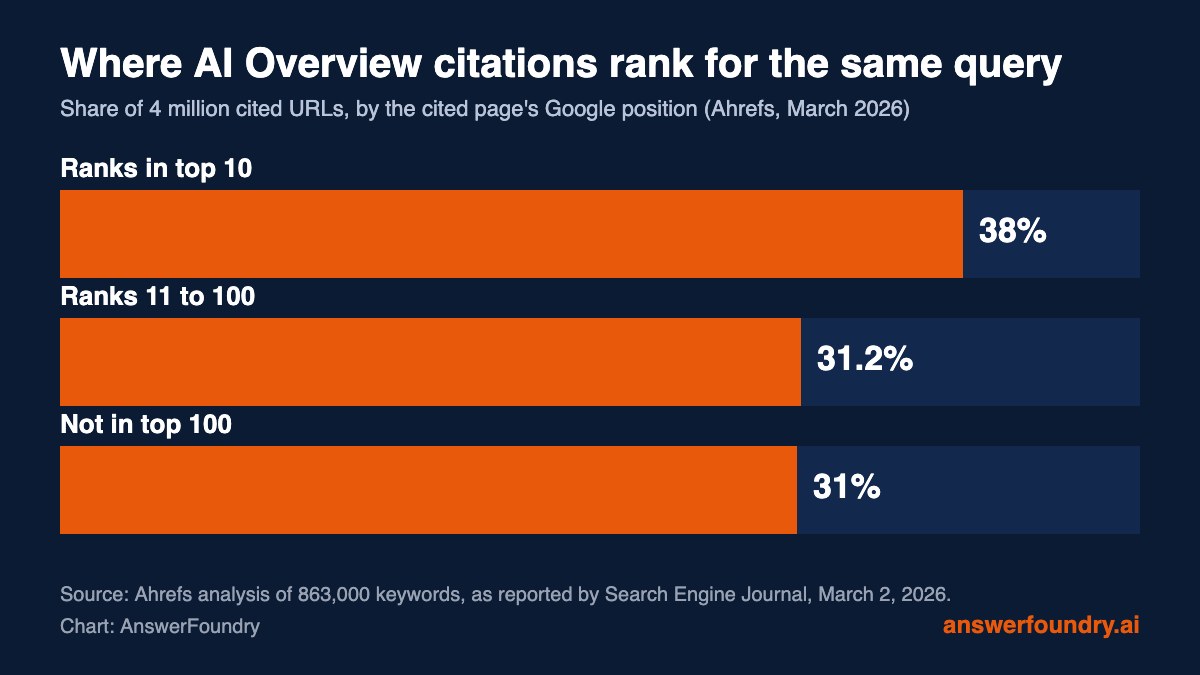
First, ranking is a weaker predictor of citation than it was a year ago. An Ahrefs analysis of 863,000 keywords and 4 million AI Overview URLs found that 38% of cited pages ranked in Google's top 10 for the same query, down from 76% in the July 2025 version of the study, with the remainder split almost evenly between positions 11 to 100 (31.2%) and beyond the top 100 (31.0%) (Southern, 2026). Ahrefs cautions that improved detection methods explain part of the drop, so the two studies are not directly comparable. Even so, roughly six in ten cited pages did not rank on page one.
Second, AI assistants overlap with Google even less. In a separate Ahrefs study of 15,000 prompts, only about 12% of URLs cited by ChatGPT, Gemini, and Copilot appeared in Google's top 10 for the original prompt, and about 80% did not rank anywhere in Google for that query at all. Perplexity was the outlier at 28.6% (Linehan & Guan, 2025). The authors attribute this to query fan-out: the assistant runs several related searches and favors pages that show up consistently across them, not the page that ranks first for one phrasing.
Third, Google says there is no ideal page length, that you do not need to "chunk" content or write in a special way for AI, and that structured data is not required for its generative features, though it remains worthwhile for rich results (Google Search Central, 2026). The practical reading of all three: a page that answers one question well, from experience, can be cited without ranking first for it, and a page that could have been written by anyone will probably lose to Reddit.
Next steps
Write down the last ten questions customers asked you by phone or email. Ask ChatGPT and Google AI each one, phrased the way the customer did, and note who gets named. For every question where you have no page, that is your content list. For every question where you do have a page, read it and ask whether it says anything a competitor could not. If not, rewrite it with your numbers and your process. Then leave it alone and check again in a month.
Orlando considerations
Central Florida has a lot of businesses that look identical on paper: same services, same service area, same star rating. In that market an AI engine choosing among a dozen similar med spas or roofing companies has to rely on whichever one gave it something specific to work with. A page explaining what a tile roof replacement in Lake Nona actually costs, with a real range and the reasons it varies, is rare in this market. That rarity is what gets a page retrieved.
Frequently asked questions
How many pages do I actually need?
Enough to answer the real questions customers ask before hiring you, which for most local businesses is somewhere between five and fifteen. More than that only helps if each additional page answers a distinct question with information you have and competitors do not.
Can I use AI to write the posts?
Google's guidance allows AI assistance as long as the result is original, helpful, and meets its spam policies. In practice, AI-drafted pages tend to be exactly the commodity content Google says adds little. Use it to structure and edit; the substance has to come from you.
Do I need to rank on page one for a page to get cited?
Not necessarily. Ahrefs' 2026 data shows about 62% of AI Overview citations came from pages outside Google's top 10 for the same query, and its 2025 study found roughly 80% of AI assistant citations did not rank in Google at all for the prompt. Ranking helps; it is not a prerequisite.
Will publishing answer pages guarantee ChatGPT names my business?
No. No one can guarantee placement in a system they do not control, including AnswerFoundry. Answer pages improve the odds by giving the engine something specific to retrieve; they do not decide the outcome.
References
Google Search Central. (2026, July 10). Optimizing your website for generative AI features on Google Search. Google for Developers. https://developers.google.com/search/docs/fundamentals/ai-optimization-guide
Linehan, L., & Guan, X. (2025, August 11). Only 12% of AI cited URLs rank in Google's top 10 for the original prompt. Ahrefs Blog. https://ahrefs.com/blog/ai-search-overlap/
Peham, T. (2026, February 1). The AI citation economy: What 1+ million data points reveal about visibility in 2026. OtterlyAI. https://otterly.ai/blog/the-ai-citations-report-2026/
Southern, M. G. (2026, March 2). Google AI Overview citations from top-ranking pages drop sharply. Search Engine Journal. https://www.searchenginejournal.com/google-ai-overview-citations-from-top-ranking-pages-drop-sharply/568637/
Last updated: September 4, 2026
If you are not sure which customer questions your site leaves unanswered, that is the first thing an AI visibility audit maps, with a prioritized list of pages to write or fix.