Published October 8, 2026
Does FAQ schema still help my business show up in AI search?
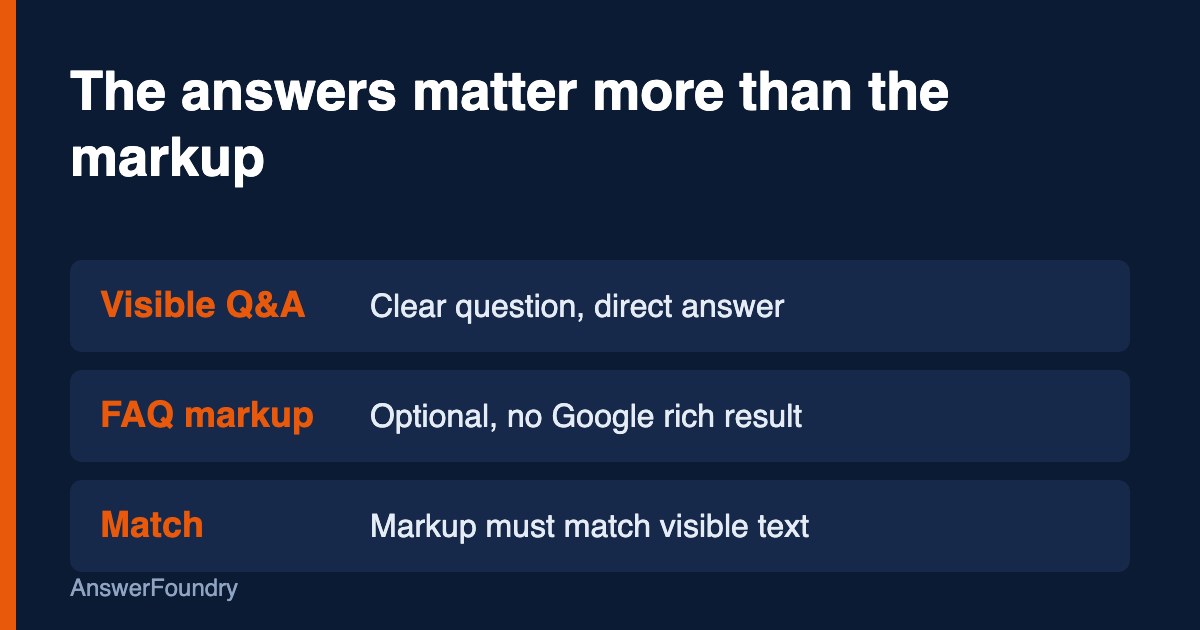
The visible Q&A content still matters; the Google rich result does not. Google changelog entries say the FAQ rich result stopped appearing in Search starting May 7, 2026. Google also says no special structured data is needed for AI Overviews, and Microsoft says clear Q&A pairs are easy for AI systems to reuse.
What this means
FAQ schema is a block of structured data that labels questions and answers on a page. For years, Google used it to show expandable FAQ results under a listing. Google has now retired that display.
Google's documentation changelog says the FAQ rich result feature would no longer appear in Google Search starting May 7, 2026, and that on June 15, 2026 it removed the FAQ documentation (Google Search Central, 2026). The entries we read concern the rich result feature; they do not say what Google now does with the markup itself.
The content is a different matter. Microsoft says Q&A pairs, with a direct question and a clear answer, are easy for assistants to lift into responses, and that schema labels content such as FAQs (Madhavan, 2025).
Who this applies to
Any business with an FAQ page or FAQ sections on service pages, and anyone who paid for or installed FAQ markup mainly to get the Google display.
How we'd evaluate it
We check:
- Visible answers. Are the questions and answers on the page as readable text?
- Question quality. Do they match what customers actually ask?
- Markup match. Does any FAQ markup match the visible text? Google advises that structured data match what is on the page (Google Search Central, 2025).
- Duplication. Are the same questions repeated across many pages?
Available options
- Keep the FAQ content. Write real answers to real customer questions.
- Keep or drop the markup. It is low cost to leave if accurate, but do not expect the Google display.
- Update the page. Lead each answer with a direct answer, then add detail.
- Stop paying for markup-only services. Do not pay for a rich result Google no longer shows.
Benefits, limitations, and tradeoffs
Writing good answers takes time and honest input from the people who answer customer calls. Markup is quick but gives less than it used to. Do not remove accurate FAQ sections just because the display is gone.
What we know
Google's changelog entries date the end of the FAQ rich result (Google Search Central, 2026). Google says no special schema.org structured data is needed for AI features, and that structured data should match visible text (Google Search Central, 2025). Microsoft recommends Q&A formats and schema labeling for content AI systems may reuse (Madhavan, 2025).
What we don't know: whether any AI product gives extra weight to FAQ markup. We have not seen documentation that says so. Our own posts keep visible FAQ sections and markup, and we do not expect a Google rich result from them.
Next steps
Open your FAQ page and read it as a customer. Rewrite weak answers so each starts with a direct answer. Leave any accurate markup in place, and stop treating it as a ranking tool.
Orlando considerations
Orlando visitors ask practical questions: parking, hours, whether you serve their area, whether you take walk-ins. Answers to those, in plain visible text, are what both customers and AI tools can use.
Frequently asked questions
Is FAQ schema dead?
The Google FAQ rich result is retired. The changelog entries we read do not say the markup is unsupported, so check Google's current documentation before removing it.
Should I delete my FAQ page?
No. The visible questions and answers still help customers and may help AI tools.
Does FAQ markup help ChatGPT?
We have not seen OpenAI document that. Clear visible Q&A is the safer bet.
Where do FAQs go?
On the page they relate to, near the content, in visible text.
References
Google Search Central. (2025, December 10). AI features and your website. Google for Developers. https://developers.google.com/search/docs/appearance/ai-features
Google Search Central. (2026, May 8 and June 15). Latest Google Search documentation updates [Changelog entries]. Google for Developers. https://developers.google.com/search/updates
Madhavan, K. (2025, October 8). Optimizing your content for inclusion in AI search answers. Microsoft Advertising. https://about.ads.microsoft.com/en/blog/post/october-2025/optimizing-your-content-for-inclusion-in-ai-search-answers
Last updated: October 8, 2026
If you want to know how AI tools describe your business today, and whether your site is getting in the way, an AI visibility audit maps it and gives you a prioritized list of what to fix first.