Published September 10, 2026
Does E-E-A-T affect whether AI engines recommend my business?
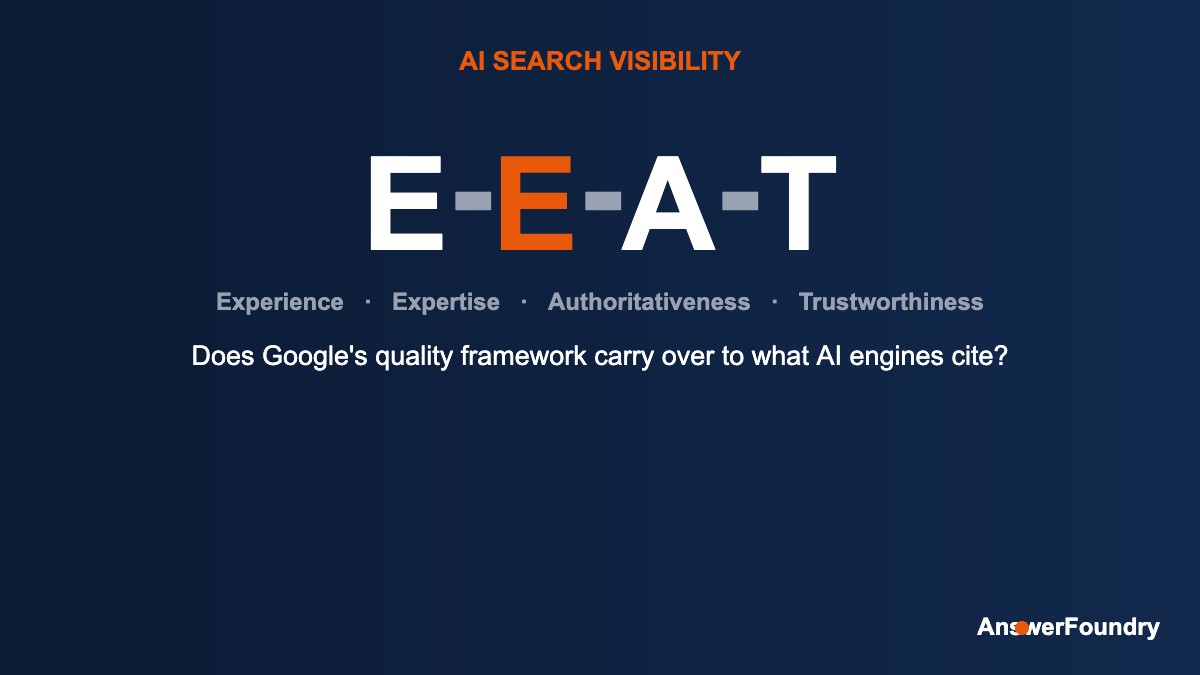
Yes, in effect, even though no AI provider publishes a scorecard that says so directly. E-E-A-T — Experience, Expertise, Authoritativeness, and Trustworthiness — is the framework Google's human quality raters have used for over a decade to judge whether a source deserves to be trusted (Google Search Central, 2022). AI Overviews and chatbots built on top of search behave the same way: they favor sources they can verify and are cautious about naming ones they can't, which is functionally an automated E-E-A-T check running on every answer.
What this means
E-A-T (Expertise, Authoritativeness, Trustworthiness) has been part of Google's Search Quality Rater Guidelines since 2014. In December 2022, Google added a second E for Experience, recognizing that first-hand use of a product or service is itself a credibility signal a generic write-up can't fake (Google Search Central, 2022). None of this is a line item in the ranking algorithm — it's a rubric quality raters use to judge content, and Google folds what it learns from that rating process back into its systems over time (Southern, 2024).
AI-generated answers inherit the same logic in a more direct form. When an engine synthesizes a response instead of returning a list of links, it has to decide, in real time, whether a source is credible enough to rely on. That decision runs on the same four questions a quality rater asks: has this source actually done the thing, does it know the subject, is it recognized by others as an authority, and can its claims be verified.
Who this applies to
Any business whose website or content plays a role in how AI engines describe it. That's a wide net: local service businesses whose pages get pulled into "best [service] near me" answers, professional practices in law, finance, or healthcare where AI is more cautious by design, and any content-driven business competing to be the cited source rather than just a ranked link. Businesses with almost no independent web presence — no reviews, no press, no third-party mentions — have the least E-E-A-T for AI systems to find, regardless of how good the on-site copy is.
How we'd evaluate it
A practical audit looks at each letter separately rather than treating E-E-A-T as one abstract score. Experience: does content show specific, first-hand detail rather than generic description. Expertise: are authors named with real, checkable credentials, and are claims backed by citations. Authoritativeness: does the business get mentioned, linked to, or reviewed by sources it doesn't control. Trustworthiness: is business information consistent across the site, Google Business Profile, and directories, and is there a real way to verify who's behind the content.
Available options
- Do nothing and rely on existing SEO work. Technical SEO and E-E-A-T are related but not identical — a fast, well-structured site can still read as anonymous or unverifiable to an AI system.
- Fix the visible gaps yourself. Add real author bios, cite sources, and make sure business information matches everywhere it appears. Free, but slow to compound without outside corroboration.
- Run a full AI visibility audit. Maps which of the four components are weakest for your specific business and market, and prioritizes fixes by likely impact.
Benefits, limitations, and tradeoffs
The benefit of focusing on E-E-A-T is that it's a durable investment — genuine credentials, real reviews, and third-party recognition don't expire the way a technical trick might. The limitation is that authoritativeness in particular is partly outside your direct control: it depends on other people and publications choosing to mention you, which takes time and can't be manufactured convincingly. It's also worth being honest that no one, including AnswerFoundry, can guarantee that improving these signals will produce a specific AI citation — the systems weigh many factors together, and behavior varies by platform and query.
What we know about E-E-A-T and AI citations
Trust is the component Google says matters most: "untrustworthy pages have low E-E-A-T no matter how Experienced, Expert, or Authoritative they may seem" (Google Search Central, 2022). Industry reporting on AI search behavior backs this up from the other direction — Search Engine Journal has described E-E-A-T as "the defining factor in determining which sources AI-driven search results consider authoritative enough to cite," noting that Google's AI Overviews lean on the same Knowledge Graph and ranking systems that E-E-A-T signals feed into (Shelby, 2025).
There's also a clear reason AI providers have an incentive to lean harder on trust signals, not less. A March 2025 Columbia Journalism Review study from the Tow Center for Digital Journalism tested eight AI search tools on their ability to correctly identify and cite news articles, and found they gave incorrect answers to more than 60% of queries — frequently with, in the researchers' words, "alarming confidence" (Jaźwińska & Chandrasekar, 2025). Interestingly, premium models were not more accurate than free ones; they were more likely to state a wrong answer confidently rather than decline to answer. That gap between confidence and accuracy is exactly the failure mode E-E-A-T-style trust signals exist to catch — it's a reasonable bet that engines under pressure to reduce citation errors will keep weighting verifiable, corroborated sources more heavily, not less.
Next steps
Start with an honest inventory rather than a rewrite: pull up your three most important pages and ask, for each, whether a stranger could tell who wrote it, what qualifies them, and whether the claims are checkable. Fix the gaps you find directly on the page — named authors, specific detail, cited sources — before spending effort chasing outside mentions, since on-site trust signals are the ones you fully control.
Orlando considerations
Central Florida's density in categories like med spas, law firms, dental practices, and home services means AI engines frequently have several similarly positioned businesses to choose between for the same query. In a crowded local market, the business with a named, credentialed author and consistent, verifiable information across its site and listings has a real edge over one with generic, unattributed content — even if the underlying service quality is comparable.
Frequently asked questions
Is E-E-A-T a direct Google ranking factor?
No. E-E-A-T is a framework in Google's Search Quality Rater Guidelines, used by human raters to evaluate content quality, not a scored signal in the ranking algorithm itself. Google uses rater data to refine its systems over time, so optimizing for E-E-A-T can indirectly help performance in both traditional search and AI-generated answers.
Which part of E-E-A-T matters most for AI citations?
Trustworthiness. Google's own guidance places trust at the center of the other three components, and an AI engine deciding whether to name a business by default is making a trust judgment first. A page can show real experience and deep expertise and still get skipped if it can't be corroborated elsewhere.
Does AI-generated content automatically hurt E-E-A-T?
Not automatically, but it raises the bar. Google has said AI-assisted content isn't inherently penalized, but it still has to demonstrate accuracy, first-hand experience, and human review. Content that reads as generic or unverified is exactly what both quality raters and AI answer engines are trained to discount.
Can a small local business realistically build E-E-A-T?
Yes, though it looks different than it does for a national publisher. Author bios with real credentials, specific first-hand details in service pages, consistent business information across the web, and third-party corroboration like reviews and local press all build E-E-A-T at a local scale.
References
Google Search Central. (2022, December 15). Our latest update to the quality rater guidelines: E-A-T gets an extra E for Experience. Google Search Central Blog. https://developers.google.com/search/blog/2022/12/google-raters-guidelines-e-e-a-t
Southern, M. G. (2024, April 24). Google E-E-A-T: What is it & how to demonstrate it for SEO. Search Engine Journal. https://www.searchenginejournal.com/google-e-e-a-t-how-to-demonstrate-first-hand-experience/474446/
Shelby, C. (2025, March 31). The role of E-E-A-T in AI narratives: Building brand authority for search success. Search Engine Journal. https://www.searchenginejournal.com/role-of-eeat-in-ai-narratives-building-brand-authority/541927/
Jaźwińska, K., & Chandrasekar, A. (2025, March 6). AI search has a citation problem. Columbia Journalism Review, Tow Center for Digital Journalism. https://www.cjr.org/tow_center/we-compared-eight-ai-search-engines-theyre-all-bad-at-citing-news.php
Last updated: September 10, 2026
If you're not sure whether your site reads as trustworthy to an AI engine the way it does to you, that's exactly the gap an AI visibility audit is built to map, with a prioritized list of what to fix first.