Published November 18, 2026
Does ChatGPT memory change which businesses it recommends?
It can. OpenAI says that when Memory is on, ChatGPT may use saved details about a person, such as their diet or their city, when it rewrites a question into a web search. Google's Personal Intelligence does something similar in AI Mode, using a person's connected Gmail and Google Photos. So two customers asking the same question can get different businesses back. What personalization can't do is recommend a business it can't find or verify, and that part is still yours to fix.
What this means
Most business owners assume an AI answer works like a ranking: one question, one answer, the same for everyone. That was never fully true, and it's getting less true. The AI engines are adding personal context on top of what they find on the web.
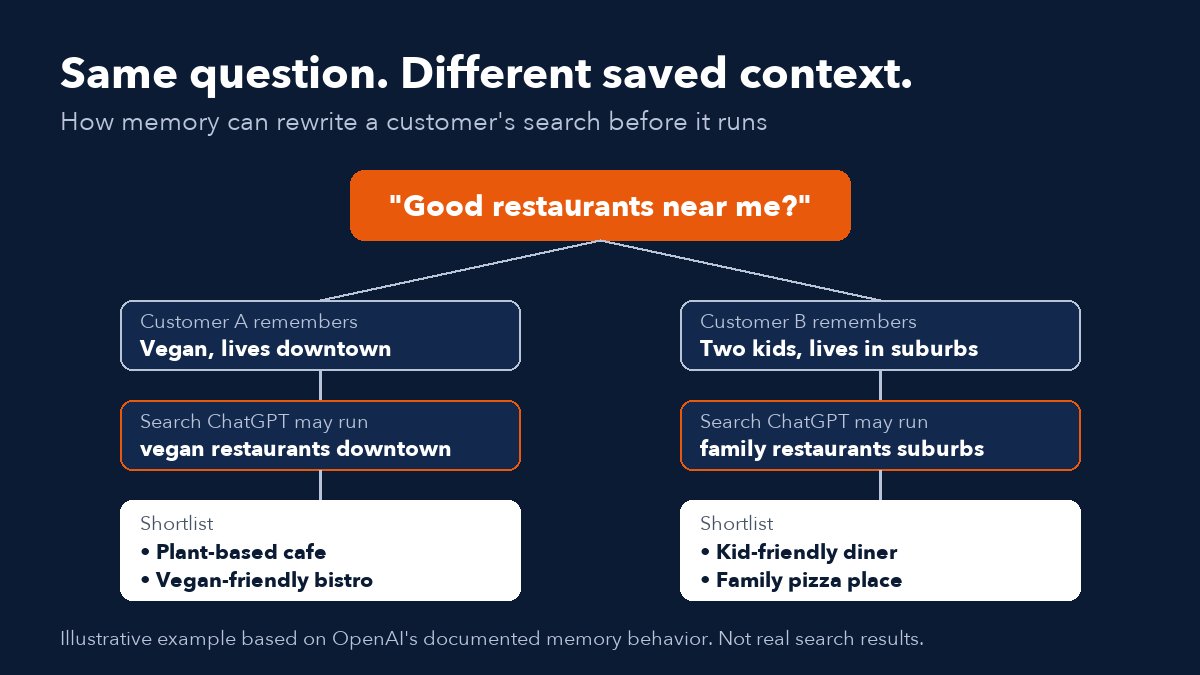
OpenAI's help center gives a concrete example. If a user has told ChatGPT they're vegan and live in San Francisco, and later asks for nearby restaurants they might like, ChatGPT may search for "good vegan restaurants San Francisco" (OpenAI, n.d.-b). The customer typed one thing. The search ChatGPT actually ran was narrower, shaped by what it remembered about them. A restaurant with no clear vegan options was dropped before the search even started.
That's the mechanism that matters for a business: memory mostly changes which question gets searched, not which businesses exist. Once the question is rewritten, the engine still has to find businesses that match it in public sources.
Who this applies to
Any business that gets found through AI assistants is affected to some degree. It matters most for businesses where customer preferences shape the choice: restaurants (diet, cuisine), medical and dental practices (insurance, language spoken), home services (budget, eco-friendly options), and law firms (practice area, consultation format). If customers regularly add "that takes my insurance" or "that's good with kids" to their questions, personal context is likely adding those filters for them now, even when they don't type them.
How we'd evaluate it
The first thing to check is your own testing. If you've been asking ChatGPT about your own business from your own account, Memory may be shaping what you see. OpenAI notes that saved memory can influence search results (OpenAI, n.d.-b). Temporary chats don't create or update memories, and before starting one you can choose whether it uses existing memories (OpenAI, n.d.-a). A cleaner test uses a temporary chat with existing memories switched off, or a signed-out session, the same question phrased a few ways, and more than one engine.
The second check is whether your public information answers the filters personalization tends to add. Does your website clearly say which insurance you take, which languages your staff speak, whether you have vegan options, what neighborhoods you serve? If a rewritten search includes one of those details and your site doesn't mention it, you're harder to match. We cover the run-it-yourself version in our 5-minute AI visibility test.
Available options
- Test in clean sessions. Use a temporary chat in ChatGPT with existing memories switched off, or a signed-out browser, so your own history doesn't skew the result.
- Spell out the details customers filter on. Put insurance, languages, dietary options, accessibility, service areas, and hours in plain text on your site and listings, not only inside images or PDFs.
- Keep listings consistent. ChatGPT may share a general location with third-party search providers to find local results (OpenAI, n.d.-b). The listings those providers return need to agree with your website.
- Track trends, not single answers. Personalization adds noise to any one test. Repeat the same prompts monthly and watch the pattern.
Benefits, limitations, and tradeoffs
The upside is real. A customer whose saved context matches what you specialize in may get a shortlist with fewer, better-matched options, and you're competing against fewer businesses for that person. The downside is that you can't see it. Personalized answers happen inside each customer's account, and no tool can show you what every customer was shown. Any vendor claiming to see inside personalized answers at scale deserves hard questions. It also means a single test from your own phone proves very little in either direction. For more on why answers vary, see why AI answers change every time.
What we know
Here's what the platforms themselves have documented, as of today:
- ChatGPT uses memory when rewriting searches. OpenAI states that if memory is enabled, ChatGPT may use relevant saved memories when rewriting a search query, and that saved location information may influence search results (OpenAI, n.d.-b).
- ChatGPT memory draws on several sources. Depending on plan and region, those can include past chats, saved memories, custom instructions, saved files, and connected apps such as Gmail (OpenAI, n.d.-a).
- Location matters even without memory. ChatGPT may estimate a general location from a user's IP address and share that general location, not the IP address itself, with third-party search providers to improve local results (OpenAI, n.d.-b).
- Users control it. ChatGPT users can review, correct, or delete what's remembered, or turn Memory off (OpenAI, n.d.-a).
- Google added personal context to AI Mode. On January 22, 2026, Google introduced Personal Intelligence in AI Mode, letting eligible users opt in to connect Gmail and Google Photos for tailored recommendations (Stein, 2026). On March 17, 2026, Google expanded it across the U.S. for AI Mode, for personal accounts but not Workspace business, enterprise, or education accounts (Marle, 2026).
What none of these sources say is how much weight personal context gets compared with the public information about a business. That isn't published, and we won't guess at it.
Next steps
Re-run your AI visibility checks in a temporary chat with existing memories off, or a signed-out session. Then make a list of the five details customers most often filter on in your category, and confirm each one appears in plain text on your website and matches your Google Business Profile. Personalization narrows the question. Your job is to make sure the narrowed question still has your name in the answer.
Orlando considerations
Central Florida gets a large number of visitors, and Google's own example of Personal Intelligence involves a traveler: AI Mode reading a hotel booking from Gmail to suggest family-friendly things to do (Stein, 2026). For Orlando restaurants, attractions-adjacent businesses, and services that visitors need on short notice, that's the scenario to plan for. Make sure your site clearly states who you're a good fit for (families, groups, dietary needs, languages spoken) and where you are relative to the places visitors are staying.
Frequently asked questions
If I test ChatGPT on my own account, is the result reliable?
Less reliable than you'd think. If Memory is on, ChatGPT may use what it knows about you, and your past searches for your own business could be part of that. Use a temporary chat with existing memories switched off, or a signed-out session, for a cleaner read, and treat any single result as one data point.
Can I get into a customer's ChatGPT memory?
Not directly, and you shouldn't try. Memory belongs to the user and is controlled by the user. What you can influence is the public information ChatGPT finds when it searches: your website, your listings, and what independent sources say about you.
Does Google's Personal Intelligence use my Google Business Profile?
Google's announcements describe Personal Intelligence as drawing on the user's own connected apps, such as Gmail and Google Photos. Your Business Profile is public information Google already uses in Search generally. Personalization changes how results are tailored to the person asking; it doesn't replace the public information about your business.
Does personalization make AI visibility tracking pointless?
No, but it changes how tracking should be done. Use clean sessions, several phrasings, and several engines, and look at trends over months rather than any single answer. A business that shows up consistently in neutral tests is in a better starting position for personalized ones too.
References
Marle, J. (2026, March 17). Personal Intelligence in AI Mode and Gemini expands in the U.S. Google. https://blog.google/products-and-platforms/products/search/personal-intelligence-expansion/
OpenAI. (n.d.-a). Memory in ChatGPT. OpenAI Help Center. Retrieved November 18, 2026, from https://help.openai.com/en/articles/8590148-memory-in-chatgpt
OpenAI. (n.d.-b). Searching the web with ChatGPT. OpenAI Help Center. Retrieved November 18, 2026, from https://help.openai.com/en/articles/9237897-searching-the-web-with-chatgpt
Stein, R. (2026, January 22). Personal Intelligence in AI Mode in Search: Help that's uniquely yours. Google. https://blog.google/products-and-platforms/products/search/personal-intelligence-ai-mode-search/
Last updated: November 18, 2026
If you're not sure whether your public information answers the questions customers actually filter on, that's exactly the gap an AI visibility audit is built to map, with a prioritized list of what to fix first.