Published September 18, 2026
Does business hours accuracy affect AI visibility?
Yes. When ChatGPT, Perplexity, or Google's AI Overviews answer "is [business] open right now", they're not reading your storefront sign — they're reading your Google Business Profile and the structured data on your website, the same machine-readable hours fields a human never sees. If those fields disagree with each other or with reality, the AI either gives a wrong answer or, more often, quietly recommends a competitor it can verify with more confidence.
What this means
Business hours aren't just a courtesy note on your website footer. They're a structured, machine-readable field — Google Business Profile has dedicated fields for main hours, special hours, and service-specific "more hours", and LocalBusiness schema on your website has an equivalent openingHoursSpecification property (Google for Developers, n.d.; Google Business Profile Help, n.d.). AI systems read both, along with any directory that lists you, and cross-check them against each other. Schema doesn't guarantee an AI engine will cite you, but it does help that engine decide whether your business is a reliable, verifiable local entity worth naming — and conflicting signals between your website and your listings create exactly the kind of friction that undermines that decision (Pizzi, 2026).
That's a different failure mode than a slow website or thin content. Hours are a factual claim, and AI answer engines are built to be cautious about repeating a factual claim they can't corroborate.
Who this applies to
Any business with hours that vary at all is exposed: medical and dental practices with different hours by location or provider, law firms with separate intake and walk-in hours, home services companies with on-call or after-hours windows, and any retail or restaurant business with holiday or seasonal hours. If your hours are the same, unchanging, 24/7 availability, this matters less — but almost no local business is actually in that position.
How we'd evaluate it
An audit checks three things side by side: what's published on your Google Business Profile (main hours, special hours, and more hours), what's marked up in your website's LocalBusiness schema, and what's listed on any directories that mention you. Then it tests the real-world question — asking ChatGPT, Perplexity, and Google AI whether you're open right now, and at specific times tomorrow — to see whether the AI's answer matches what's actually true and where it's pulling from.
Available options
- Run the DIY check. Compare your Google Business Profile hours, your website's schema, and reality. Free, and it catches the most common gap: special hours that were never set for an upcoming holiday.
- Book a full AI visibility audit. Checks hours consistency alongside the other identity and structured-data signals AI systems weigh together, not in isolation.
- Ongoing monitoring. Hours drift — a schedule change gets updated on the website and forgotten on the Business Profile, or vice versa. Monthly tracking catches that drift before it compounds with other conflicts.
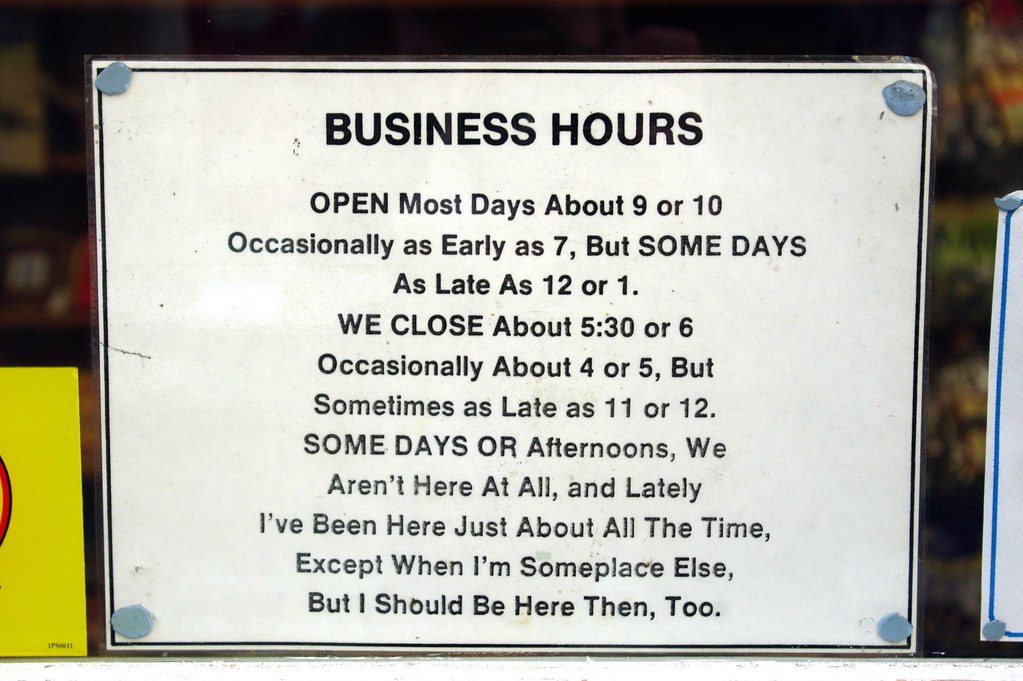
Photo: "Business Hours" by madnzany, CC BY 2.0
Benefits, limitations, and what this won't tell you
The benefit is that this is one of the more fixable signals in AI visibility work — there's no ambiguity about what the "correct" answer is, unlike judgment calls around content depth or E-E-A-T. The limitation is timing: updating your Google Business Profile doesn't mean every AI engine reflects it instantly, since each platform re-crawls and re-weighs sources on its own schedule. It also won't tell you whether hours specifically are costing you a citation versus some other inconsistency — that requires testing hours in isolation from your other signals.
What we know
Google's own structured data documentation lists openingHoursSpecification, alongside address and geo coordinates, as a core identifying signal for LocalBusiness schema (Google for Developers, n.d.). Search Engine Land's reporting on schema and AI visibility describes hours as one of the fields AI systems check for agreement across a business's website, Google Business Profile, and directory listings — noting that "one conflict may be ignored, but multiple conflicts can compound and result in lost search visibility" (Pizzi, 2026). And the stakes for getting this right are rising quickly: BrightLocal's 2026 Local Consumer Review Survey found that consumer use of generative AI tools for local business recommendations jumped from 6% to 45% in a single year, making AI tools the third most popular source of business recommendations behind only Google and word of mouth (Murphy, 2026). A field that used to matter mainly for a Google Maps pin now feeds a fast-growing share of how customers find out whether you're even open.
Next steps
Check your Google Business Profile's main hours and confirm special hours are set for the next major holiday. Confirm your website's LocalBusiness schema includes an accurate openingHoursSpecification that matches. Then run the real-world test: ask two or three AI engines whether you're open right now and see if the answer is correct.
Orlando considerations
Central Florida's density in categories like med spas, dental practices, law firms, and home services means an AI engine usually has several similarly positioned businesses to choose from. When one candidate's hours are inconsistent and another's aren't, that's an easy tiebreaker in the AI's favor toward the business it can verify — which makes hours accuracy a small fix with outsized leverage in a competitive local market.
Frequently asked questions
Isn't updating Google Maps enough?
Maps and Search reflect whatever hours are set on your Google Business Profile, but that's only one signal. AI systems also read the LocalBusiness schema markup on your website and any directories that list you, and they weigh agreement across sources. If your GBP says one thing and your site's schema says another, that's a conflict for the AI to resolve, not a fact it can confidently repeat.
Can wrong hours actually cause an AI engine to skip recommending me?
There's no evidence of a direct penalty for one wrong field. But AI answer engines favor businesses they can verify with confidence, and conflicting or stale hours are one more inconsistency working against that confidence. Enough small conflicts across your listings can compound into an AI engine choosing a competitor it can verify more easily.
How often do I actually need to check this?
Monthly is a reasonable baseline, the same cadence we recommend for AI visibility generally. Add a check every time your operating hours change and before every holiday, since holiday and special hours are the most commonly missed update.
Does this matter if I don't have a walk-in location?
Yes. If you publish any hours of availability, phone support windows, on-call service hours, live chat coverage, the same structured data and consistency logic applies. AI engines treat published availability as a factual claim to verify, not a formality.
References
Google for Developers. (n.d.). Local Business (LocalBusiness) structured data. Google Search Central Documentation. https://developers.google.com/search/docs/appearance/structured-data/local-business
Google Business Profile Help. (n.d.). Edit your business hours. https://support.google.com/business/answer/15300403
Murphy, R. (2026, February 11). LCRS 2026: Study shows reviews matter more than ever. BrightLocal. https://www.brightlocal.com/research/local-consumer-review-survey/
Pizzi, G. (2026, March 6). How structured data supports local visibility across Google and AI. Search Engine Land. https://searchengineland.com/schema-local-visibility-google-ai-470906
Last updated: September 18, 2026
If you're not sure whether your hours, or any other signal, are consistent across the places AI engines actually look, that's exactly the gap an AI visibility audit is built to map.