Published August 28, 2026
Do YouTube videos help my business show up in AI search?
Sometimes — but less often, and in a narrower way, than the "just post more video" advice suggests. In a 30-day analysis of more than 100 million AI citations published by Otterly.AI in March 2026, social media and video domains together accounted for 5.54% of all citations, and YouTube made up 31.8% of that slice. Video is a real path into AI answers. It is not the main one, and for some engines it is barely a path at all.
What this means
AEO (answer engine optimization) is the work of getting named inside an AI-generated answer. SEO earns you a slot in a list of links; AEO earns you a spot in the answer itself, where there is no list. When an AI engine writes that answer, it pulls from sources it can retrieve and verify — web pages, business listings, forum threads, and sometimes video.
The question is how much of that citation surface video actually occupies. In the Otterly.AI dataset, brand-owned domains accounted for 52.2% of all citations and news and media sources for 20.3%, while social and video platforms together accounted for 5.54%. So a YouTube video is a legitimate additional source an engine can reach for. It is not where most of the answer comes from.
Who this applies to
This is worth acting on if your business already produces explainer video, or realistically would — walkthroughs, procedure explanations, comparisons, "what to expect" pieces. It matters much less if nobody at the business is going to record a ten-minute explainer, in which case the website is the better place to spend the effort.
It also depends heavily on which engines your customers use. In the same study, YouTube citations were concentrated in Perplexity (38.7% of all YouTube citations) and Google AI Overviews (36.6%), followed by Google AI Mode (19.6%). ChatGPT accounted for 4.4%, Microsoft Copilot 0.5%, and Gemini 0.2%. If the buying questions in your category are being asked in ChatGPT, video is close to irrelevant to whether you get named.
How we'd evaluate whether video is worth it
We start by testing the actual buying questions across several engines and recording who gets named and what gets cited. If no video appears in the citations for your category on any engine, that answers the question before anyone buys a microphone. If video does appear, the next checks are whether it is long-form or short, whether it carries chapters, and whether the descriptions read like metadata or like an afterthought. Those are the variables that showed movement in the published data.
Available options
- Chapter the video you already have. The cheapest option by a wide margin. It costs an afternoon of editing descriptions and changes nothing about the video itself.
- Build one structured long-form reference video. A single thorough explainer with clean chapters, rather than a run of short clips.
- Fix the site first and revisit video later. For most businesses this is still the correct sequence, given where the citations actually land.
Benefits, limitations, and tradeoffs
The benefit is that video citations behave differently from ranking. In the Otterly.AI data, popularity metrics showed near-zero correlation with how often an already-cited video was cited again: views at r = -0.03, likes at r = -0.02, and channel subscribers at r = -0.03. In that dataset 40.83% of cited videos had fewer than 1,000 views, and 35% of cited channels had fewer than 10,000 subscribers. A small channel is not disqualified.
The limitations are significant and worth stating plainly. That study looked only at videos that had already been cited at least once, so it describes what makes a cited video get cited again — not how a video earns its first citation. The authors note the same constraint themselves, along with the standard caveat that correlation in observational data is not evidence of cause. And the platform split means any video strategy is a bet on specific engines rather than on AI search generally.
What we know
Google's own documentation is the firmest ground here. Its guide to optimizing for generative AI features, last updated 10 July 2026, states that generative AI search features can bring in relevant images and video, and that site owners already following Google's image and video SEO documentation are already optimizing for generative AI search (Google Search Central, 2026). The same guide is unusually direct about what does not work: no special AI markup is needed, llms.txt files are ignored by Google Search, and structured data is not a requirement for generative AI features.
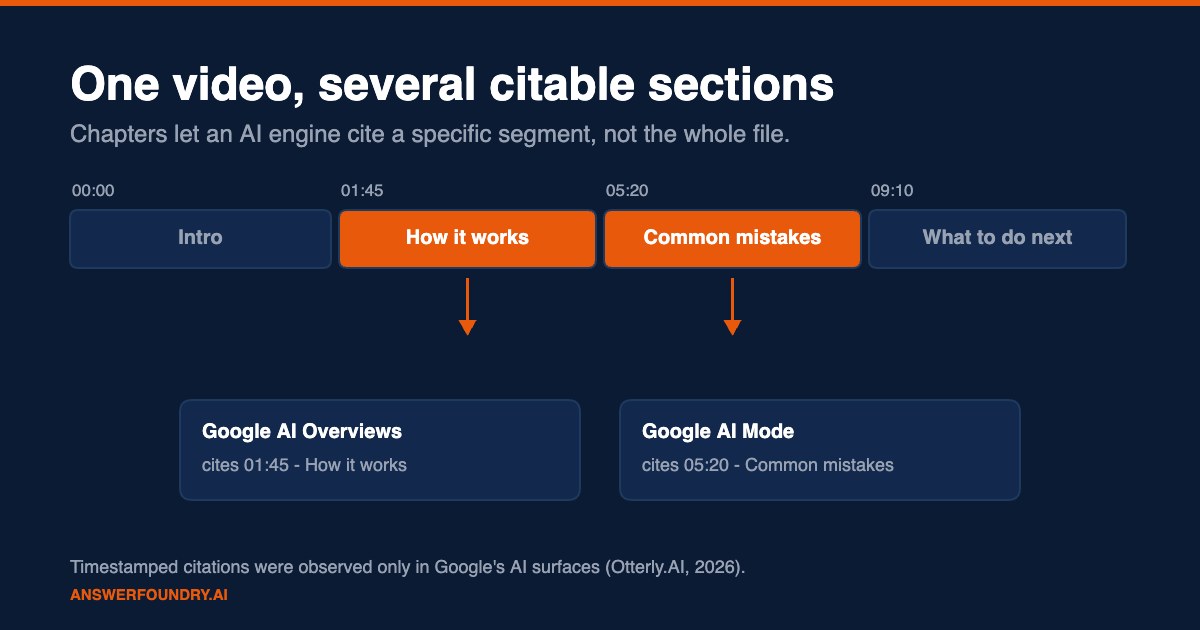
On structure, the clearest finding in the Otterly.AI study concerns chapters. Long-form videos accounted for 94% of YouTube citations, with Shorts at 5.7% and playlists, channels, and livestreams together at 0.3%. Timestamped citations appeared only inside Google's AI surfaces — 73% in AI Overviews and 27% in AI Mode — with none observed in ChatGPT, Gemini, Copilot, or Perplexity during the observation window. Among videos carrying timestamps, 78% were cited more than once, commonly across two to five different chapters, which suggests those systems treat a chapter as a citable unit rather than treating the video as one object (Tousseyn, 2026).
Chapters themselves are governed by rules YouTube publishes directly: the first timestamp must start at 00:00, there must be at least three timestamps in ascending order, and the minimum chapter length is 10 seconds (YouTube Help, n.d.). If chapters are not rendering, the cause is usually one of those three conditions, not the content.
Next steps
If you already have video, add properly formatted chapters and rewrite the descriptions so they summarize the video and name the specific topics covered. That is a low-cost change with a plausible upside inside Google's AI surfaces and no meaningful downside anywhere else. If you have no video, don't start there — run the buying-question test first and see whether video appears in your category's citations at all.
Orlando considerations
Central Florida service categories like med spas, dental practices, law firms, and home services are crowded enough that engines have several similar-looking businesses to choose between. Video does not resolve that on its own, and we have not measured a local-market effect specific to Orlando. What consistently precedes any of this is the boring work: consistent name, address, and phone details across your site and listings, and content that answers the question a customer actually asked.
Frequently asked questions
Do I need a big YouTube channel before AI engines will cite my videos?
The 2026 Otterly.AI citation study found near-zero correlation between how often a cited video was cited again and its view count (r = -0.03), likes (r = -0.02), or channel subscriber count (r = -0.03). In that dataset, 40.83% of cited videos had fewer than 1,000 views. That said, the study only looked at videos that had already been cited at least once, so it explains repeat citation better than it explains how a video gets picked the first time.
Are YouTube Shorts worth making for AI visibility?
Not primarily for citations. In the same 2026 study, long-form videos accounted for 94% of YouTube citations and Shorts for 5.7%, with the Shorts share concentrated inside Google's AI surfaces. Shorts may still be worth making for reach and brand recognition, which are different goals from being cited as a source.
Should I move budget from my website to video?
We would not recommend that on the strength of the current data. In the 2026 Otterly.AI dataset, social media and video domains together accounted for 5.54% of all AI citations, while brand-owned domains accounted for 52.2%. Your own site is still where most of the citation surface is. Video is an addition, not a replacement.
Does adding chapters to a video actually change anything?
In the 2026 study, timestamped YouTube citations appeared only in Google AI Overviews (73%) and Google AI Mode (27%), with none observed in ChatGPT, Gemini, Copilot, or Perplexity during the observation window. Among videos that carried timestamps, 78% were cited more than once, often across two to five chapters. Chapters are cheap to add and low-risk, but the observed benefit is specific to Google's AI surfaces, and correlation in an observational dataset is not proof of cause.
References
Google Search Central. (2026, July 10). Optimizing your website for generative AI features on Google Search. Google for Developers. https://developers.google.com/search/docs/fundamentals/ai-optimization-guide
Tousseyn, R. (2026, March 2). The YouTube citation study 2026. Otterly.AI. https://otterly.ai/blog/youtube-ai-citation-study-2026/
YouTube Help. (n.d.). Video chapters. Google. Retrieved August 28, 2026, from https://support.google.com/youtube/answer/9884579
Last updated: August 28, 2026
If you want to know whether video is worth your time in your specific category, the first step is finding out what the engines currently cite when someone asks for a business like yours — which is exactly what an AI visibility audit maps.