Published October 10, 2026
Do title tags and meta descriptions help my business show up in AI search?
They help the page make sense, with limits. Microsoft says the page title, meta description, and H1 are signals AI systems use to interpret a page's purpose and scope. Google says it may rewrite title links and only sometimes uses the meta description. Write them clearly and make them agree with each other.
What this means
The title tag is the page name that appears in the browser tab and often in search results. The meta description is a short summary in the page code. The H1 is the main headline on the page.
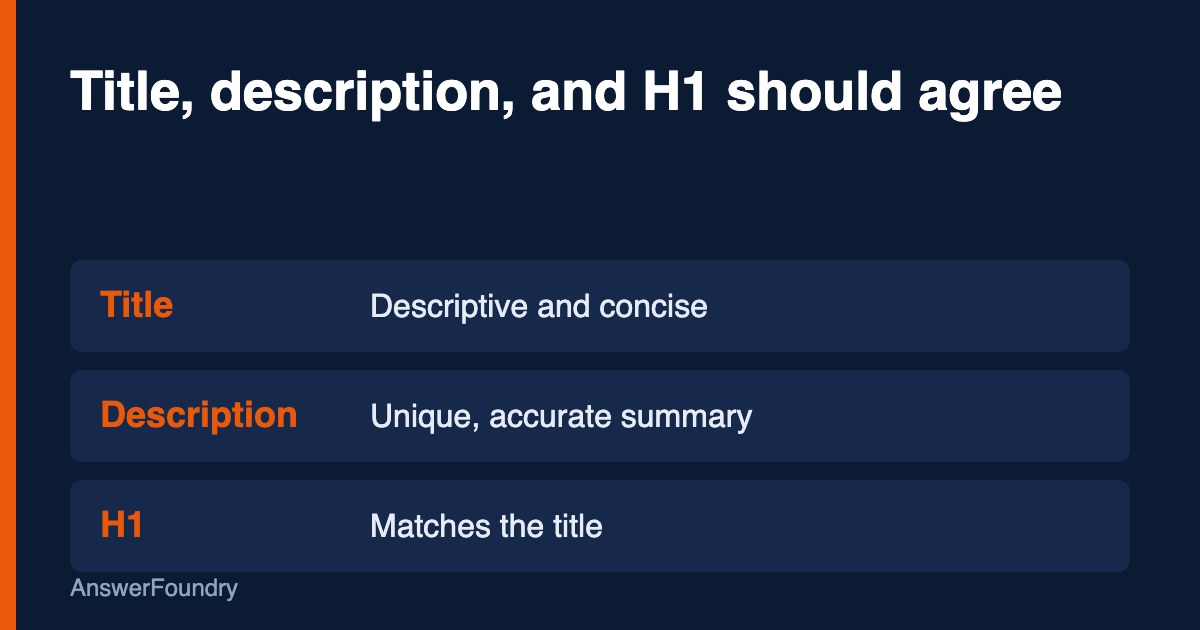
Microsoft says the page title, meta description, and H1 are important signals AI systems use to interpret purpose and scope, and that the H1 should match or closely reflect the title (Madhavan, 2025).
Google says titles should be descriptive and concise, avoid keyword stuffing and boilerplate, and that Google may rewrite a title link using the H1, og:title, anchor text, and other sources (Google Search Central, 2025). It says it sometimes uses the meta description when that describes the page better than the page text, and that snippets are otherwise built from page content (Google Search Central, 2026).
Who this applies to
Every business site, especially ones where the same title or description is repeated across many pages.
How we'd evaluate it
We review:
- Titles. Unique, descriptive, and short enough to read.
- Descriptions. One accurate summary per page.
- H1 match. Does the headline agree with the title?
- Boilerplate. Do many pages share the same text?
Available options
- Rewrite generic titles. Replace "Home" or "Services" with something specific.
- Write unique descriptions. One per page, no keyword lists.
- Align the H1. Match the title.
- Do the top pages first. Start with the pages customers reach most.
Benefits, limitations, and tradeoffs
This is cheap and quick. The limit is that Google may rewrite titles and often ignores descriptions, so do not expect exact text to appear anywhere.
What we know
Microsoft names title, description, and H1 as interpretation signals (Madhavan, 2025). Google gives specific writing guidance and says it may modify titles (Google Search Central, 2025), and that meta descriptions are used only sometimes (Google Search Central, 2026).
What we don't know: how much any AI product weighs these tags against body content. No platform publishes that.
Next steps
List your top ten pages with their title, description, and H1. Fix any that are generic, duplicated, or disagree. Then ask customer-style questions in ChatGPT and Google and see how your pages are described.
Orlando considerations
Many Orlando businesses use the same title pattern on every page. Add the specific service and area, such as "Roof inspection in Winter Park", where it is accurate.
Frequently asked questions
Are meta descriptions a ranking factor?
Google describes them as a summary it sometimes uses. It does not call them a ranking factor in the page we read.
How long should a title be?
Google advises concise, descriptive titles and does not give a fixed length.
Should the H1 match the title?
Microsoft says they should match or closely reflect each other.
Will Google use my exact title?
Not always. Google says it may modify title links.
References
Google Search Central. (2025, December 10). Influencing your title links in search results. Google for Developers. https://developers.google.com/search/docs/appearance/title-link
Google Search Central. (2026, April 20). How to write meta descriptions. Google for Developers. https://developers.google.com/search/docs/appearance/snippet
Madhavan, K. (2025, October 8). Optimizing your content for inclusion in AI search answers. Microsoft Advertising. https://about.ads.microsoft.com/en/blog/post/october-2025/optimizing-your-content-for-inclusion-in-ai-search-answers
Last updated: October 10, 2026
If you want to know how AI tools describe your business today, and whether your site is getting in the way, an AI visibility audit maps it and gives you a prioritized list of what to fix first.