Published October 13, 2026
Do tables and bullet lists help my business show up in AI search?
A little, in some cases. Putting facts like prices, hours, and service lists into a real table or a short bulleted list makes them easier for a machine to read and quote. But Google says no special formatting is required to appear in AI Overviews, and a 2026 test found the correct fact came back about 94% of the time whether it sat in a table, a bullet, or a paragraph. Accurate, visible facts matter more than the shape they're in.
What this means
AI engines pull pieces of a page, not the whole page. A table row that reads "Teeth whitening, $350, Tuesday to Thursday" is one clean, self-contained fact. The same fact buried in the fourth sentence of a long paragraph is harder to lift out and harder to attribute. That's the reasoning behind the advice to use tables and lists, and it's sensible. The question is how much evidence there is that it changes outcomes.
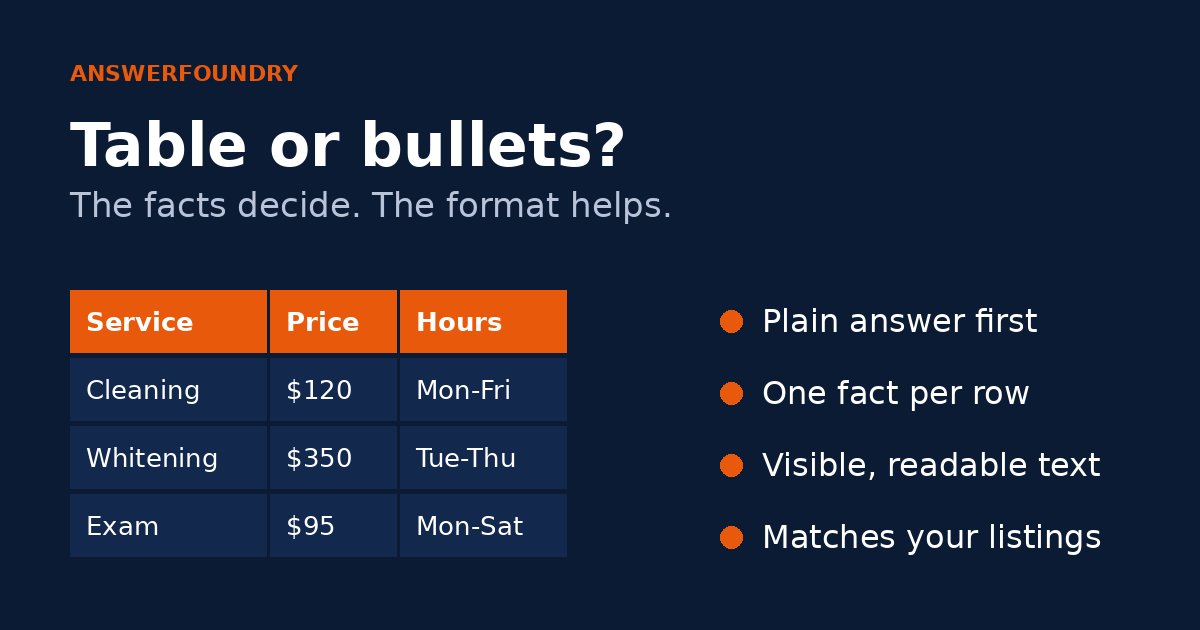
The honest answer is: some, but less than most guides claim. Formatting helps when the content is a real comparison or a set of discrete facts. It does nothing for facts that are missing, vague, or contradicted elsewhere on the web.
Who this applies to
Any business with facts people compare: service menus, pricing tiers, hours, service areas, insurance accepted, certifications, or "best for" breakdowns. Dental practices, med spas, law firms, and home services companies all have this kind of content. If your site is mostly a story about your company with few concrete details, the first fix is adding the details, not changing the layout.
How we'd evaluate it
We'd look at which pages hold comparison-style facts and how they're currently presented. Is the price list a real HTML table, or a screenshot? Are services listed as separate lines, or tucked into a long paragraph? Then we'd check that every fact in the table matches your Google Business Profile and other listings. A clean table with an outdated price is worse than a messy paragraph with the right one.
Available options
- Leave it alone. If your key facts are already clear, visible text, reformatting is low priority.
- Convert true comparisons to tables. Services and prices, plans side by side, hours by location. Use real HTML tables, not images.
- Use short lists for steps and criteria. Keep each item a complete, specific statement rather than a vague label.
Benefits, limitations, and tradeoffs
The benefit is clarity for both people and machines, and it costs little. The tradeoffs are real, though. Tables can read poorly on a phone if they're wide. Lists strip out the reasoning that makes a recommendation believable. And over-formatting a page that should explain something turns it into a spec sheet. Use the format that fits the content.
What we know
Google's own documentation is direct: there are no additional requirements to appear in AI Overviews or AI Mode, and no special markup or AI-specific files are needed. It does advise making sure important content is available in textual form (Google Search Central, 2025). That supports using real text and real HTML tables over images of tables.
The strongest data in favor of structure is observational. AirOps analyzed 217,508 pages that ChatGPT retrieved across 7,500 commercial queries and compared cited pages with retrieved-but-not-cited ones. Lists were the strongest shared signal across buying stages, with pages containing 7 to 26 list sections 6% to 15.2% more likely to be cited. Comparison pages with three tables earned 25.7% more citations (Davidson, 2026). The authors measured association, not cause, so this doesn't prove that adding tables earns citations.
A controlled test points the other way on accuracy. 5W Public Relations wrote 40 brand facts in four formats and ran 2,400 tests across ChatGPT, Claude, and Perplexity. The correct value appeared 93.5% to 94.6% of the time regardless of format. Perplexity named the publisher 66% of the time for table content versus 55% for a third-sentence paragraph, but the position of the document in the set shifted that rate by about 32 points, roughly three times the formatting effect (Carothers, 2026). The test covered one window in July 2026, 40 consumer-brand facts, and no repeated runs, and the author's firm sells related services, so weigh it accordingly.
Put together: structure may nudge how often you're named, but it's a small lever next to whether the facts are correct, present, and consistent.
Next steps
Pick your three most important comparison pages, usually services, pricing, and locations or hours. Make sure each key fact is in visible text, ideally in a real table or a short list, and confirm it matches your Business Profile and directory listings. Then re-run your AI visibility test in a month. Don't rewrite the whole site for formatting.
Orlando considerations
In Orlando, many searches are comparisons: which dentist takes my insurance, which med spa has weekend hours, which contractor serves Winter Park. Those are exactly the facts that fit a table. Because several competitors often sit within a few miles, an accurate, easy-to-read service and hours table, consistent with your listings, is a cheap way to remove doubt about what you offer and where.
Frequently asked questions
Should I turn all my paragraphs into tables?
No. The 2026 5W test found the correct fact appeared 93.5% to 94.6% of the time whatever the format, a spread of 1.1 points. Use a table where the content is a real comparison, like services and prices, and keep explanations as normal sentences.
Does Google require tables or lists to appear in AI Overviews?
No. Google's documentation says there are no additional requirements to appear in AI Overviews or AI Mode, and no special markup or AI-specific files are needed. It does ask that important content be available as text.
Can I put my price list in an image instead of a table?
It's a poor idea. Google advises making sure important content is available in textual form. A price list saved as an image can't be read the way an HTML table can, and it's harder to keep consistent with your other listings.
Will adding tables guarantee more AI citations?
No. The AirOps findings are associations from observational data, not proof that adding tables causes citations. AI engines are third-party systems outside anyone's control, so treat formatting as one small signal among many.
References
Carothers, K. (2026, August 12). Do tables and bullets increase AI citations? New findings from 2,400 tests. 5W Public Relations. https://www.5wpr.com/new/do-tables-and-bullets-increase-ai-citations-new-findings-from-2-400-tests/
Davidson, O. (2026, April 1). From retrieved to cited: How commercial content earns citations in AI search. AirOps. https://www.airops.com/report/from-retrieved-to-cited-how-commercial-content-earns-citations-in-ai-search
Google Search Central. (2025, December 10). AI features and your website. Google for Developers. https://developers.google.com/search/docs/appearance/ai-features
Last updated: October 13, 2026
If you want to know whether your key facts are readable, correct, and consistent across the places AI engines look, that's what an AI visibility audit checks.