Published October 6, 2026
Do duplicate pages on my website hurt my AI search visibility?
Possibly, indirectly. Google says duplicate or very similar pages are not a spam violation, but it recommends consolidating them so signals go to one URL. For AI Overviews, Google says a page must be indexed and eligible to show with a snippet. We have not seen a platform document an AI-specific duplicate penalty.
What this means
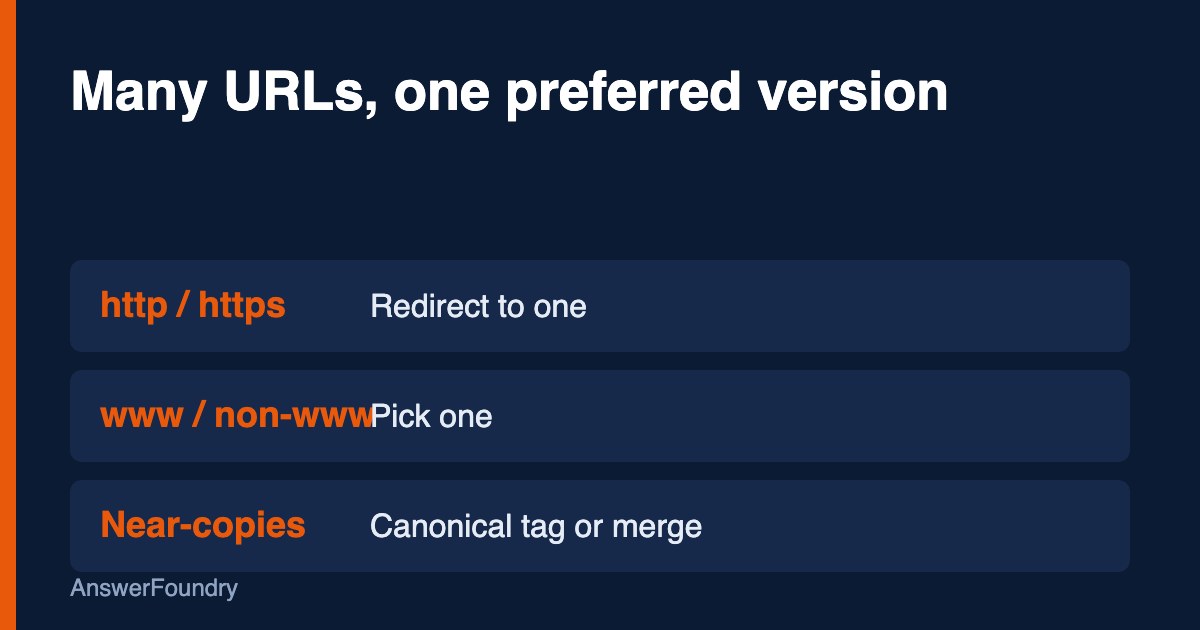
A duplicate page is the same or very similar content at more than one web address. It happens by accident: http and https versions, www and non-www, URLs with tracking parameters, or location pages cloned with only the city name changed.
Google's documentation says that if you do not specify a canonical, Google chooses the version it considers best. It lists consolidating signals for similar pages and reducing wasted crawling as goals. It calls rel="canonical" and permanent redirects strong signals, and a sitemap listing a weak one, and says none of the methods are required (Google Search Central, 2026).
Google's starter guide says duplicate content is not a spam violation, but recommends one accessible URL for each piece of content (Google Search Central, 2025b).
Who this applies to
Any site with multiple URL versions, copied location or service pages, printer-friendly versions, or parameter-filled links. Multi-location businesses and sites built with page builders are common examples.
How we'd evaluate it
We check:
- Protocol and host. Do http, https, www, and non-www all resolve to one version by redirect?
- Near-duplicate pages. Are there location pages with the same text and a swapped city name?
- Canonical tags. Does each page point to the right preferred URL?
- Sitemap. Does it list only the preferred URLs?
Available options
- Redirect old versions. Use permanent redirects to retire duplicates.
- Set canonical tags. Add rel="canonical" on pages that must stay live.
- Rewrite thin near-copies. Give each location or service page its own real details.
- Clean the sitemap. List only preferred URLs.
Benefits, limitations, and tradeoffs
Redirects and canonical tags take care to set up, and mistakes can point to the wrong page. Google also notes that many sites do fine without these methods, so a small clean site may need little. Rewriting near-duplicate pages takes real effort but also gives customers something useful.
What we know
Google describes canonicalization methods as signals of varying strength and says its eligibility rule for AI Overviews is that the page is indexed and eligible to appear with a snippet (Google Search Central, 2025a, 2026). Google says duplicate content is not a spam violation (Google Search Central, 2025b).
What we don't know: whether duplicates affect which version an AI tool cites. If several URLs carry the same content, the logical risk is that signals are split, but no source we reviewed measures this.
Next steps
Type your site address into a browser in four ways (http, https, with and without www) and confirm all land on one version. Then list any pages whose text is nearly identical to another and rewrite or merge them.
Orlando considerations
Orlando businesses with several service areas often clone one page per neighborhood. Make each page real: local details, services offered there, and photos, not a swapped city name.
Frequently asked questions
Will duplicate pages get me penalized?
Google says duplicate content is not a spam violation. The issue is split signals and wasted crawling, not a penalty.
What is a canonical tag?
A line in the page head that names the preferred URL for similar pages. Google treats it as a strong signal.
Do I need one if my site is small?
Google says none of the methods are required and many sites do fine without them. Check that the basic URL versions redirect.
Are redirects better than canonical tags?
Google calls both strong signals. Use redirects when you are retiring a page, and canonical tags when both pages need to stay live.
References
Google Search Central. (2025a, December 10). AI features and your website. Google for Developers. https://developers.google.com/search/docs/appearance/ai-features
Google Search Central. (2026, July 10). How to specify a canonical URL with rel="canonical" and other methods. Google for Developers. https://developers.google.com/search/docs/crawling-indexing/consolidate-duplicate-urls
Google Search Central. (2025b, December 10). Search engine optimization (SEO) starter guide. Google for Developers. https://developers.google.com/search/docs/fundamentals/seo-starter-guide
Last updated: October 6, 2026
If you want to know how AI tools describe your business today, and whether your site is getting in the way, an AI visibility audit maps it and gives you a prioritized list of what to fix first.