Published September 26, 2026
Do “best of” lists help my business show up in AI answers?
Often, yes, but mainly when your business is on someone else’s list. When a customer asks an AI assistant to compare options, the answer almost always cites a list-style article, and local “who’s good near me” questions cite one most of the time. Research also shows businesses placed higher on those lists tend to get recommended more often. Writing your own list and ranking yourself first is a different story: Google appears to be demoting that tactic, and presenting a list you control as independent can create problems under FTC rules.
What this means
A “best of” list, sometimes called a listicle, is an article like “The 10 best roofers in Orlando” or “Top CRM tools for small businesses.” AI answer engines like ChatGPT, Perplexity, and Google’s AI Overviews often use retrieval-augmented generation: they search the web, pull in a handful of sources, and then write a new answer in their own words. A list article is convenient for that process. It is focused on one question, it is already organized, and it has already done the comparison work.
The scale is large. In a sponsored analysis published on Search Engine Land, the AI marketing platform Evertune reviewed about 25,000 of the most-cited URLs across ChatGPT, Copilot, Gemini, Google AI Mode, AI Overviews, and Perplexity. Half were listicles, and across nearly 400 million citations, 63% pointed to listicles (Evertune, 2026). That is a vendor’s own analysis, so treat the exact figures with some caution, but the direction matches independent studies below.
Who this applies to
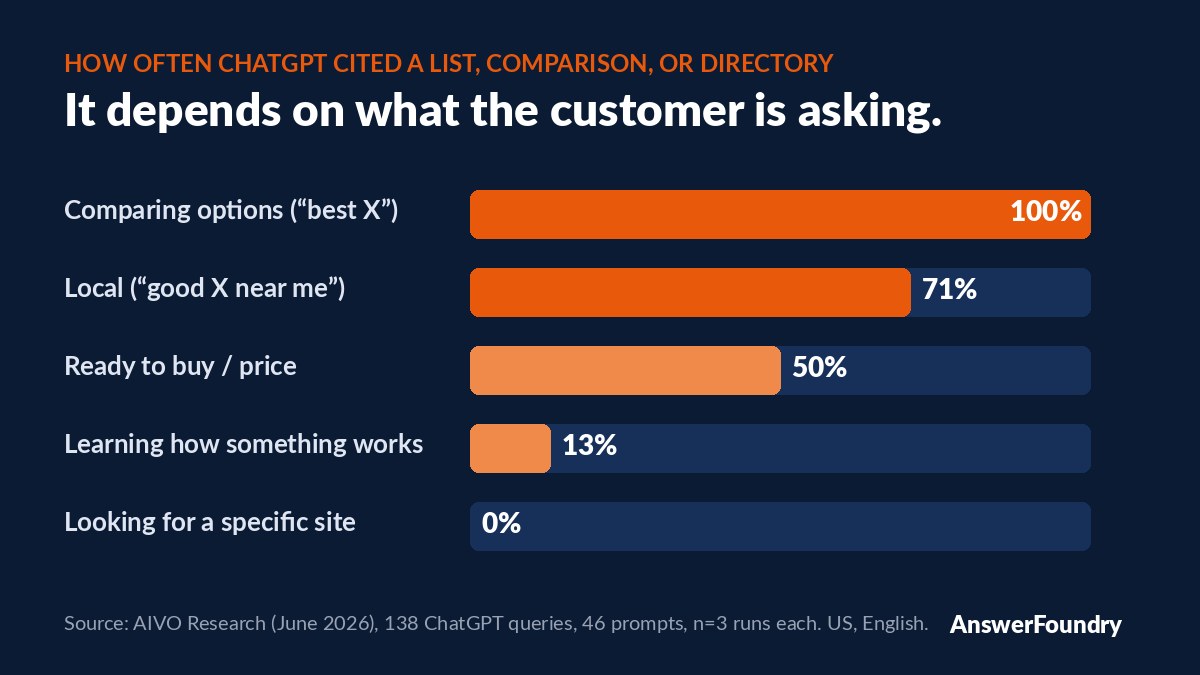
This matters most for businesses whose customers compare before they hire: law firms, contractors and home services, accounting and financial practices, real estate agents, and healthcare or aesthetics practices, among others. In an AIVO Research study of 138 ChatGPT queries, answers to “best X” comparison questions cited a list, comparison, or directory source 100% of the time. Local questions like “who’s a good dentist in Miami?” did so 71% of the time. Informational questions (13%) and questions looking for a specific website (0%) rarely did (Pinzon Duran, 2026). If your customers mostly ask how something works, lists matter less.
How we’d evaluate it
- Run the questions your customers ask. Try them in ChatGPT, Perplexity, and Google AI Mode, and open every source the answer cites.
- Sort the sources. Note which are list articles, which are directories, and which are individual business websites.
- Check each list for your business. Are you on it? Where? Is your name, location, and service description accurate? When was the list last updated?
- Review your own site. If you’ve published lists that rank your own business first, check whether they disclose that you wrote them and whether they give readers real alternatives.
Available options
- Earn a place on third-party lists. Local publications, trade associations, chambers of commerce, and reputable directories publish roundups. Make sure their editors have accurate, current information about your business, and ask how they choose who gets included.
- Fix what’s already out there. If you’re on a list with an old address, a closed location, or a service you no longer offer, ask the publisher to correct it.
- Publish an honest comparison on your own site. If you write one, say plainly that it’s yours, explain your criteria, and link to the alternatives you name. Ahrefs says this is its own approach, including not always putting itself first (Allsopp, 2025).
- What we don’t recommend: dozens of thin, self-ranked lists refreshed with the current year and little else.
Benefits, limitations, and tradeoffs
The benefit is straightforward. Lists are one of the places AI engines look when a customer asks them to compare, so being accurately represented on the right ones gives the engine something to work with.
The limitations are real. The research shows correlation, not cause. Ahrefs found brands placed higher on lists were more likely to be recommended, but its own author notes some built-in bias in that result and says the team is still studying it (Allsopp, 2025). Most of these studies focus on software, products, and agencies at a national level, not on local service businesses. The AIVO study covers one engine, ChatGPT, in the US and in English (Pinzon Duran, 2026).
Self-promotional lists carry their own risk. Search Engine Land reported research by Lily Ray of Amsive showing several SaaS brands lost 30% to 50% of their Google visibility within weeks in early 2026, concentrated in blog sections full of lists that ranked the publisher first. Google has not confirmed a change, and other factors likely played a part (Goodwin, 2026). Separately, the FTC’s rule on consumer reviews and testimonials, in effect since October 21, 2024, prohibits a business from misrepresenting that a review website it controls is independent (Federal Trade Commission, 2024).
What we know
Ahrefs analyzed ChatGPT responses to 750 prompts about software, products, and agencies. “Best X” blog lists made up 43.8% of all cited page types. Of 1,100 cited lists with clear dates, 79.1% had been updated in 2025, and 26% in the previous two months. About 35% of cited lists sat on low-authority domains, which the author expects AI platforms to filter more over time (Allsopp, 2025).
AIVO found that 92% of cited listicles carried the current year in the title, the median list had 10 items, and ChatGPT spread “best X” citations across more than 300 domains, with no single domain above about 3% (Pinzon Duran, 2026). In other words, you don’t have to be featured by a national publisher. Being on current, credible lists in your category counts.
Next steps
- List five to ten questions your customers would ask an AI assistant before hiring you.
- Run them in at least two AI engines and record every list article cited.
- Check whether you appear on each list, and whether the details are correct.
- Contact publishers of relevant, current lists with accurate information about your business.
- Audit any self-ranked lists on your own site for clear authorship, stated criteria, and links to alternatives.
Orlando considerations
Local “best of” content in Central Florida usually comes from regional publications, reader-voted awards, neighborhood guides, and directories, not from national tech sites. Our expectation, not a measured figure, is that there are far fewer of these lists for a given Orlando service category than for a national software category, so a single current, credible local list may carry more weight in an AI answer. Stale local lists are common, too. If a roundup names a business that closed two years ago, the publisher may welcome a correction.
Frequently asked questions
Should I pay to be included on a “best of” list?
Be careful. Some lists sell placements, and a paid spot that isn’t labeled as paid can mislead the customers reading it. We don’t recommend it. Ask any list publisher how they choose entries, and focus on lists that pick businesses on their own criteria.
Can I publish a “best of” list on my own website?
Yes, if it’s honest. Say clearly that your business wrote it, explain how you compared options, and include real alternatives with links. Don’t present a list you control as an independent review; the FTC’s rule on consumer reviews and testimonials prohibits that.
Does my position on the list matter?
It appears to. Ahrefs found that brands placed higher on cited lists were more likely to be recommended by ChatGPT. That’s a correlation, not proof that moving up a list will change what AI says about you.
Do lists need to be recent to get cited?
Recent lists appear to be favored. AIVO found 92% of the listicles ChatGPT cited carried the current year in the title, and Ahrefs found 79.1% of cited lists had been updated in 2025. An outdated list is less likely to be used.
References
Allsopp, G. (2025, December 4). Do self-promotional “best” lists boost ChatGPT visibility? Study of 26,283 source URLs. Ahrefs. https://ahrefs.com/blog/best-lists-research/
Evertune. (2026). AI search loves listicles: What 25,000 URLs reveal about citations [Sponsored content]. Search Engine Land. https://searchengineland.com/ai-search-loves-listicles-what-25000-urls-reveal-about-citations-477682
Federal Trade Commission. (2024, November 8; updated 2025, May 1). The Consumer Reviews and Testimonials Rule: Questions and answers. https://www.ftc.gov/business-guidance/resources/consumer-reviews-testimonials-rule-questions-answers
Goodwin, D. (2026, February 4). Google may be cracking down on self-promotional ‘best of’ listicles. Search Engine Land. https://searchengineland.com/google-cracking-down-self-promotional-best-of-listicles-468227
Pinzon Duran, S. (2026, June 22). Are listicles the AI-search silver bullet? A ChatGPT study. AIVO Research. https://www.tryaivo.com/resources/research/chatgpt-listicle-silver-bullet-june-2026
Last updated: September 26, 2026
Knowing which lists AI engines trust in your category, and whether you’re on them, is part of what an AI visibility audit maps, along with a prioritized list of what to fix first.