Published November 20, 2026
Can I use ChatGPT for SEO?
Yes, as an assistant, not as the person in charge. ChatGPT is good at brainstorming topics, drafting outlines, rewriting clunky paragraphs, and producing first drafts of title tags or schema markup. It's poor at anything that depends on real data it doesn't have, like search volume or what's actually ranking today, and it can state wrong facts with full confidence. Google doesn't penalize content just because AI helped write it. It does expect a person to check everything before it goes live.
What this means
"Using ChatGPT for SEO" can mean two very different things. One is using it as a writing and thinking tool: asking it for content angles, turning your notes into a draft, or tightening a service page that rambles. The other is handing it the job, letting it pick keywords, write pages, and publish them with little review. The first can save a small business real time. The second is where most of the risk sits.
Google's position has been consistent since early 2023. Using automation, AI included, is not a problem on its own. Using it mainly to manipulate rankings is a spam-policy violation (Google Search Central, 2023). Google's current guidance goes further on quality: generative models predict likely wording rather than retrieve facts, so outputs can contain errors, and Google calls manual fact-checking of AI-generated content, metadata included, critical before publishing (Google Search Central, 2026).
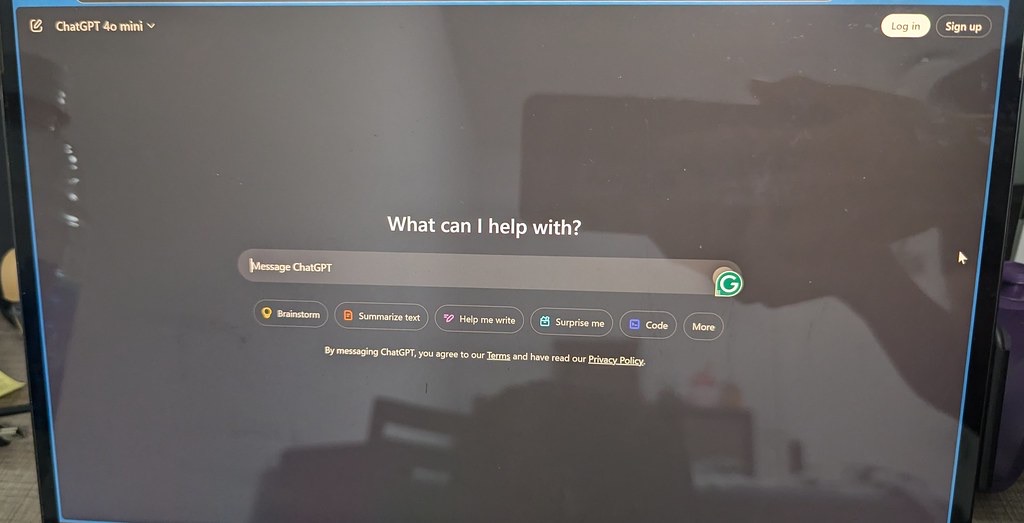
Photo: "ChatGPT home screen" by raife3, CC0 1.0 (public domain dedication)
Who this applies to
This is mostly a question for owner-operators and small marketing teams: a practice manager writing the website in between other jobs, a contractor who wants a blog but has no writer, or an agency trying to move faster. If you already have a content process with a subject-matter expert reviewing every page, ChatGPT slots in as a drafting aid. If nobody on your side knows the subject well enough to catch a wrong claim, you should be more careful about using it at all, because it won't flag its own mistakes.
How we'd evaluate it
When we look at a site that leans on AI-assisted content, we're not trying to detect whether ChatGPT wrote it. We check what Google and AI answer engines actually respond to:
- Accuracy. Are the facts, prices, hours, credentials, and service details on the page right? A confident wrong detail does more damage than a missing one.
- Specificity. Does the page say something only your business could say, like real cases, local details, or your own process? Or could it describe any company in your category?
- Scale. Were dozens of near-identical pages published quickly, such as one per suburb with only the city name swapped? Google's guidance specifically warns that generating many pages without added value may fall under its scaled content abuse policy (Google Search Central, 2026).
- Metadata. Were AI-written title tags and meta descriptions checked against what each page actually says?
Available options
In practice, these are the uses we'd consider reasonable, roughly from safest to riskiest:
- Brainstorming questions and topics. Ask it for the questions a customer might have about your service, then check demand in a real keyword tool. Search Engine Land's guide to keyword research with ChatGPT makes the same point: it has no access to search volume or the other metrics that tools like Google Keyword Planner, Semrush, and Ahrefs provide, but it's useful for ideation (Demers, 2024).
- Outlines and restructuring. Turning a wall of text into a page with clear headings and a direct answer up top. This is low risk because you're supplying the facts.
- Drafting technical snippets. First drafts of FAQ text, title tags, or JSON-LD schema, followed by validation and a human read.
- First drafts of full articles. Workable if an expert rewrites and fact-checks them. Risky if they're published as-is.
- Bulk page generation. The option we'd steer most businesses away from, for the scaled-content reasons above.
Benefits, limitations, and tradeoffs
The benefit is speed. A blank page is the hardest part of content work for most small businesses, and ChatGPT removes it. It's also patient, so you can ask it to rewrite a paragraph ten ways until one sounds like you.
The limitations are real. OpenAI's own help center says ChatGPT can produce incorrect or misleading answers, can sound confident when it's wrong, and can invent quotes, studies, and citations to sources that don't exist (OpenAI, n.d.). Without its search tool, it also only knows what was in its training data up to a cutoff date. For SEO, that means any statistic, competitor claim, or "best practice" it hands you needs checking against a primary source. There's a quieter tradeoff too: if you and your competitors all ask the same tool the same question, you'll get similar pages, and similar pages give search engines and AI answer engines little reason to prefer yours.
What we know
Google has said plainly that it rewards high-quality content however it's produced, and that AI or automation used to manipulate rankings violates its spam policies (Google Search Central, 2023). Its current documentation adds three practical expectations: check AI output for accuracy before publishing, metadata included; don't mass-produce pages that add no value; and hold AI-assisted work to the same Search Essentials and spam-policy standards as anything else (Google Search Central, 2026).
OpenAI's guidance points the same way from the other side. It recommends treating ChatGPT's output as a first draft rather than a final source, and verifying quotes, data, and references directly, especially when accuracy matters (OpenAI, n.d.). Practitioners say much the same. Demers (2024) describes ChatGPT as a big time-saver for some SEO tasks and clearly worse than existing tools for others, and keyword metrics fall in the second group.
What nobody publishes is a formula for how much AI assistance is "too much." Neither Google nor OpenAI offers one, so we don't either. The workable rule is the one both companies describe: a knowledgeable person stays responsible for what gets published.
Next steps
If you want to try it, start with one existing page instead of a new one. Paste in your current service page, ask ChatGPT to suggest a clearer structure and a plain-language answer for the top of the page, then rewrite its suggestions in your own words and check every factual claim. Confirm keyword ideas in a real keyword tool before building a page around them. And keep a simple log of which pages were AI-assisted and who reviewed them, so you can revisit them if guidance changes.
Orlando considerations
Local businesses in Central Florida have an advantage here that ChatGPT can't copy: first-hand local knowledge. Which neighborhoods you actually serve, how summer storm season changes your scheduling, which insurance plans you take, what tourists versus residents usually ask you. Generic AI drafts tend to flatten all of that into "serving the greater Orlando area." The details are what make a page worth citing, so if you use ChatGPT for the draft, add the local specifics yourself.
Frequently asked questions
Will Google penalize my site for using ChatGPT?
Not for using it as such. Google's stated position is that appropriate use of AI isn't against its guidelines, while using automation mainly to manipulate rankings, or mass-producing pages without added value, is. The safest approach is human review of everything before it's published.
Can ChatGPT do keyword research?
Partly. It's useful for brainstorming the questions and phrases customers might use, but it doesn't have access to real search volume or difficulty data the way dedicated keyword tools do. Treat its suggestions as ideas to check, not numbers to rely on.
Do I need to tell readers that AI helped write a page?
Google suggests disclosing AI or automation where a reader would reasonably wonder how the content was made. For an ordinary service page that a person edited and fact-checked, most businesses won't need a label. For content mostly produced by automation, a short note is reasonable.
Will using ChatGPT help me show up in ChatGPT's answers?
Not directly. Writing your pages with ChatGPT doesn't give you any special standing in its answers. AI answer engines draw on what they can find and corroborate about your business across the web, so accuracy, specificity, and consistency matter far more than which tool drafted the text.
References
Demers, T. (2024, December 23). How to use ChatGPT for keyword research (with actual prompts). Search Engine Land. https://searchengineland.com/keyword-research-chatgpt-prompts-393741
Google Search Central. (2023, February 8). Google Search's guidance about AI-generated content. Google Search Central Blog. https://developers.google.com/search/blog/2023/02/google-search-and-ai-content
Google Search Central. (2026, October 1). Google Search's guidance on using generative AI content on your website. Google for Developers. https://developers.google.com/search/docs/fundamentals/using-gen-ai-content
OpenAI. (n.d.). Does ChatGPT tell the truth? OpenAI Help Center. Retrieved November 20, 2026, from https://help.openai.com/en/articles/8313428-does-chatgpt-tell-the-truth
Last updated: November 20, 2026
If you're not sure whether your AI-assisted pages are helping or quietly hurting, an AI visibility audit checks what Google and AI answer engines actually say about your business, and which pages are behind it.