Published August 27, 2026
Can I pay to show up in AI answers?
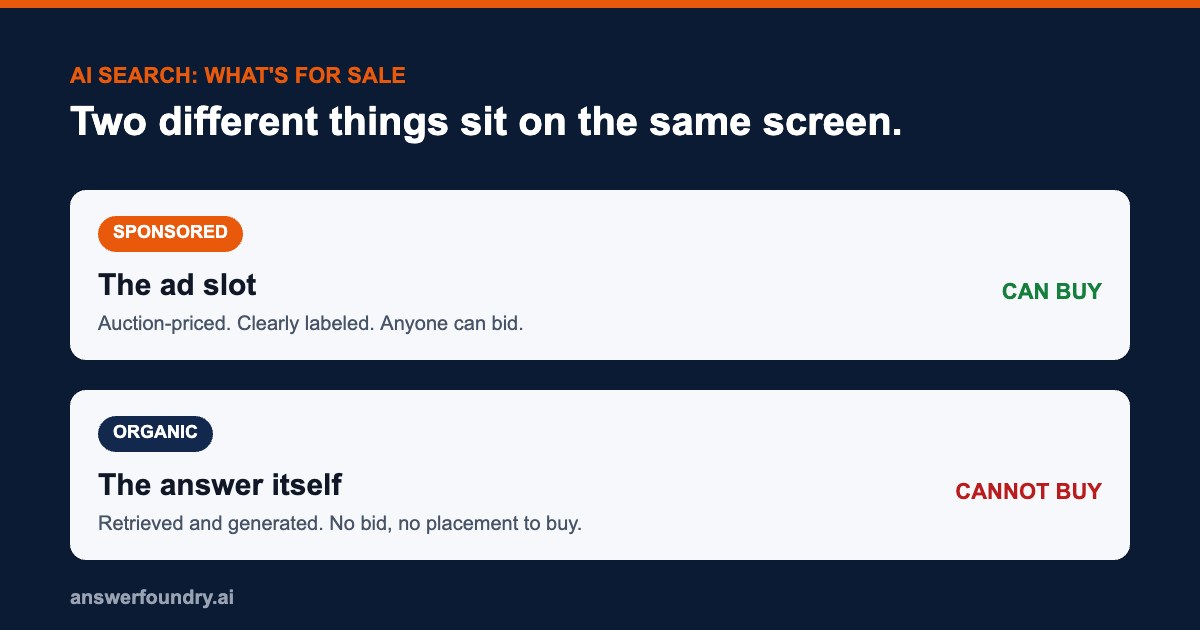
Partly. You can buy a labeled ad slot beside — and in some cases inside — an AI answer. Google and OpenAI both sell one now. What you cannot buy is the answer itself: the sentence that names a business as the recommendation is generated from retrieved content, and no ad account moves you into it.
What this means
The natural assumption is that AI search works like paid search: if you are not showing up, you bid. That assumption is now half right, which is worse than being entirely wrong, because it makes it easy to buy the wrong thing.
Two separate systems share one screen. One is an auction — an ad slot, clearly labeled, sold to whoever wins it. The other is the answer, assembled by retrieval: the engine pulls content it has already indexed, then writes a synthesized response in its own words. SEO earns you a slot in a list of links. AEO — answer engine optimization — earns you a spot inside that generated answer, with no list at all. Money reaches the first system. It does not reach the second.
Who this applies to
Anyone whose customers ask an AI assistant a hiring question — and especially anyone in a regulated category, because the ad half may not be available to you at all. Google states that it does not currently show ads in AI Overviews for sensitive verticals including adult, alcohol, gambling, finance, healthcare, and politics (Google Ads Help, n.d.). OpenAI states that ads in ChatGPT are not eligible to appear near sensitive or regulated topics including personal health, mental health, and politics (OpenAI, n.d.).
If you run a medical practice, a wealth-management firm, or an aesthetics clinic, the practical read is that inside AI answers you are organic-only right now, whether or not you have a budget.
What you can actually buy today
Google. Ads are eligible to be shown above, below, or within AI Overviews on Search. The above-and-below placements run in all 200+ markets where AI Overviews are available. Ads shown within an AI Overview are narrower: currently English-language, on mobile and desktop, in Australia, Canada, India, Indonesia, Kenya, Malaysia, New Zealand, Nigeria, Pakistan, Philippines, Singapore, and the US. They are drawn from existing Search, Shopping, and Performance Max campaigns, and they are matched against both the user's query and the content of the AI Overview itself (Google Ads Help, n.d.).
OpenAI. ChatGPT ads began as a US test on 9 February 2026 for logged-in adults on the Free and Go tiers, and had expanded to Canada, Australia, New Zealand, and then the UK, Mexico, Brazil, Japan, and South Korea as of an 11 August 2026 update. Plus, Pro, Business, Enterprise, and Education accounts do not see them. Ads appear below the end of a response, labeled as sponsored and visually separated from it (OpenAI, 2026).
How we'd evaluate this for a business
Three questions, in order. First: is your category even eligible for ads in these surfaces? If it is on either provider's excluded list, the paid path is closed and the question answers itself. Second: when you ask the engines the question a real customer would ask, are you absent from the answer, or absent from the ad slot? Those are different failures with different fixes. Third: is the AI's description of your business accurate? An ad buy does nothing about a wrong service list or a stale address, and a click that lands on a business the engine just described incorrectly is an expensive way to lose someone.
Benefits, limitations, and tradeoffs
The honest case for the ad slot is that it is fast, it is measurable, and it puts you in front of high-intent exploration you could not previously reach. The limitations are unusually sharp for a paid channel. Google states that advertisers cannot directly target the in-AI-Overview placement, cannot opt out of it, and do not currently get segmented reporting for it — those impressions are simply reported as Top Ads. Google also notes the placement requires AI-powered targeting such as broad match, AI Max, Performance Max, Shopping, or Dynamic Search Ads, because advertisers are unlikely to be bidding on the long, complex questions that trigger AI Overviews in the first place (Google Ads Help, n.d.).
So you are buying exposure in a placement you cannot choose, cannot decline, and cannot isolate in a report. That is a real channel with real reach. It is not a substitute for being in the answer.
What we know
The providers are unusually direct about the separation. OpenAI's documentation states that ads do not influence ChatGPT's answers, that ads run on separate systems from the chat model, and that advertisers have no ability to shape, rank, or alter ChatGPT's responses; it also states that seeing an ad does not mean OpenAI endorses the advertiser (OpenAI, n.d.).
On the organic side, Google Search Central is equally direct about what does not exist: "There are no additional requirements to appear in AI Overviews or AI Mode, nor other special optimizations necessary." To be eligible as a supporting link, a page has to be indexed and eligible to be shown in Google Search with a snippet, and nothing more (Google Search Central, 2025). Its 2026 guide on generative AI features goes further and names the tactics that do not work for Google Search — llms.txt files and other special markup, "chunking" content, rewriting pages for AI systems, and seeking inauthentic mentions — while noting that indexing and serving are never guaranteed (Google Search Central, 2026).
Two things follow. There is no paid door into the organic half. And there is no clever door either — which is the part most "AEO hack" pitches are quietly selling.
Next steps
Run the free version of this test before spending anything. Ask ChatGPT, Google, and Perplexity the question a stranger looking for your service would actually type. Note who gets named in the answer, and separately note whether an ad appeared at all. If your category shows no ads, stop pricing the ad path. If you are missing from the answer but the engine describes you accurately, that is a corroboration problem. If the description itself is wrong, that is a signals problem, and it is the cheaper of the two to fix.
Orlando considerations
Central Florida's most competitive categories — law, home services, real estate, aesthetics, financial practices — split awkwardly across that line. Home services and real estate can generally buy the ad slot. Financial and healthcare practices largely cannot, under the exclusions above. For an Orlando business in the second group, the paid shortcut that a competitor in another vertical can take simply is not on the menu, which makes the organic signals the entire game rather than one lever among several.
Frequently asked questions
Can I pay Google to be cited in an AI Overview?
No. Google Ads Help states that ads are eligible to show above, below, or within AI Overviews, but that advertisers cannot directly target the in-AI-Overview placement and cannot opt out of it. The organic supporting links inside an AI Overview come from indexed pages that meet Google's normal Search requirements, not from an ad account.
Do ChatGPT ads change what ChatGPT recommends?
OpenAI's published position is no. Its help documentation states that ads do not influence ChatGPT's answers, that ads run on separate systems from the chat model, and that advertisers have no ability to shape, rank, or alter responses. Ads appear below the end of a response, labeled as sponsored and visually separated from it.
Are AI ads available to every kind of business?
No. Google states it does not currently show ads in AI Overviews for sensitive verticals including adult, alcohol, gambling, finance, healthcare, and politics. OpenAI states ads are not eligible to appear near sensitive or regulated topics including personal health, mental health, and politics. Businesses in those categories are effectively organic-only inside AI answers today.
If I can't buy the answer, what actually gets a business into it?
Google Search Central states there are no additional requirements to appear in AI Overviews or AI Mode and no special optimizations necessary — a page has to be indexed and eligible to be shown in Search with a snippet, and the same SEO fundamentals apply. That is the work: being crawlable, described consistently, and corroborated by sources the engine already trusts. Nothing about it is purchasable, and nothing about it is guaranteed.
References
Google Ads Help. (n.d.). About ads and AI Overviews. Google. https://support.google.com/google-ads/answer/16297775
Google Search Central. (2025, December 10). AI features and your website. Google for Developers. https://developers.google.com/search/docs/appearance/ai-features
Google Search Central. (2026, July 10). Optimizing your website for generative AI features on Google Search. Google for Developers. https://developers.google.com/search/docs/fundamentals/ai-optimization-guide
OpenAI. (2026, August 11). Testing ads in ChatGPT. OpenAI. https://openai.com/index/testing-ads-in-chatgpt/
OpenAI. (n.d.). Ads in ChatGPT. OpenAI Help Center. https://help.openai.com/en/articles/20001047-ads-in-chatgpt
Last updated: August 27, 2026
If you want to know which half of this you should be spending on — the ad slot or the signals — that's what an AI visibility audit sorts out, with the eligibility question answered before you commit a budget.